
Custom Mouthguards for Kids
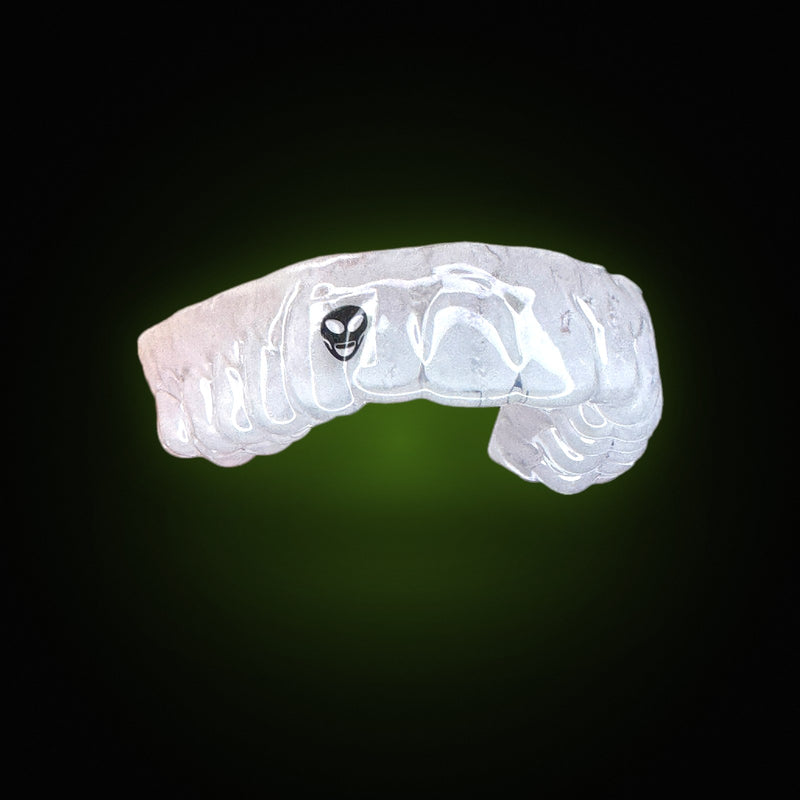
A custom mouthguard for kids is made from an impression of your child's own teeth, so it stays in during games instead of being held in by biting. That fit is the main difference from a boil-and-bite or stock guard, and it is why many parents switch once their child is in a contact or high-fall sport such as football, basketball, hockey or martial arts. Mouthguards help protect against chipped, cracked or knocked-out teeth in those sports.
AlienGuards are custom made in the USA from that impression. NanoBite, our slim 4 mm guard, is the usual pick for youth team sports. Origin and Origin Pro are the 5 mm combat guards for youth boxing, MMA, Muay Thai, kickboxing, karate and taekwondo. Because young mouths are still growing, plan to check the fit every season and replace the guard when baby teeth fall out or adult teeth come in. Basketball parents can also see why mouthguards matter in basketball.
What's different for kids
- No age limit. Younger athletes' teeth are still changing, so plan to replace their guard more often (see how often to replace a mouthguard).
- Braces are fine. Athletes with braces can get AlienGuards, but their dentist needs to take the impression instead of using our at-home kit, so the braces don't get damaged. Your dentist can take an impression or 3D scan, then ship it to us or email it to impressions@alienguards.com. Some youth sports add rules for braces: USA Boxing needs a signed Release to Compete with Braces form, and NFHS high school wrestling requires a mouthguard that covers the braces. See mouthguard rules with braces, sport by sport. If your child has a retainer, another dental appliance or loose teeth, talk to your dentist before using the kit. Every order requires a liability waiver.
- Tray size. The impression kit comes with one tray in your child's size, picked from the smile photo you take when you order. Our team confirms the size before the kit ships, and you get enough putty for two tries in case the first one doesn't come out right.
Which AlienGuards guard suits each youth sport
Pick the model by the sport, not by age:
- Youth football, wrestling, jiu-jitsu, rugby, hockey, field hockey, basketball, lacrosse, soccer, volleyball, baseball and softball: NanoBite, our ultra-slim 4 mm guard. It is the best of our models for breathing, talking and calling plays. See the NanoBite collection.
- Youth boxing, MMA, Muay Thai, kickboxing, karate and taekwondo: Origin or Origin Pro, our 5 mm combat guards. Origin Pro has the same 5 mm protection with more breathability and comfort, plus an optional High Impact 6 mm upgrade.
Sport guides: soccer (rules), field hockey (rules), karate and taekwondo, football, basketball (rules), lacrosse (rules), hockey, rugby (rules), wrestling, volleyball and baseball and softball. Cheer parents can check cheerleading mouthguard rules. Non-combat guards are 4 mm thick, and combat guards are 5 mm. See the sizing and fit guide and the model comparison. Kids who compete in jiu-jitsu can check BJJ mouthguard rules for each tournament. Young Muay Thai fighters can check Muay Thai mouthguard rules, including WBC youth gear. Young boxers can check boxing mouthguard rules.
Custom vs boil-and-bite for kids
For kids, a custom mouthguard is usually the better everyday option than a boil-and-bite or stock guard, because it stays in without clenching and is easier to talk in. A custom guard is more comfortable and secure than a store-bought one. It does not slip or fall out, and it is easier to keep in for a whole game. For how custom, boil-and-bite and stock guards compare, see why custom mouthguards outperform boil-and-bite. Dental groups describe three types. Stock guards come ready to wear in a few sizes; the AAPD notes they must be held in place by clenching, which can interfere with breathing and speaking, and the ADA calls them the least effective type. Boil-and-bite guards are the most used, but the AAPD says they vary greatly in protection, retention, comfort and cost. The AAPD states that custom-fabricated guards are superior in retention, protection and comfort. A guard kids are comfortable wearing is one they will actually keep in. More in mouthguard myths debunked.
What the research says about kids' teeth in sports
The American Academy of Pediatric Dentistry (AAPD) cites an average of about 22,000 dental injuries a year in children under 18 between 1990 and 2003, and says 50% to 90% of sports dental injuries involve the upper front teeth. In high school data it reviewed, the highest dental injury rates were in girls' field hockey and boys' basketball, and most injured athletes were not wearing a mouthguard. The American Dental Association (ADA) summarizes a 2019 review that found mouthguard users were 82% to 93% less likely to suffer dentofacial injuries. A mouthguard has not been proven to prevent concussions, so think of it as protection for teeth, lips and gums (see do mouthguards prevent concussions?).
Fit and habit matter as much as owning a guard. In one study cited by the AAPD, 29% of children given free mouthguards never wore them and only 23.2% wore them whenever they needed to. In a 2023 study where dentists checked the guards of 106 young Gaelic football players, 81% had inadequate retention and 84% did not reach far enough over the front teeth toward the gums. In a 2021 study of 121 young Gaelic football players and 118 parents from the same Trinity College Dublin team, 99.2% of players said they wore a guard in games but only 80.8% in training, and 73.7% of parents believed custom guards protect better, yet only 3.8% of the children had one. Sources and more detail are in Protecting Your Child's Smile.
How to get your child to actually wear it
In one study cited by the AAPD, 32% of children given free mouthguards wore them only occasionally, on top of the 29% who never did. The AAPD names comfort and speech as big reasons kids stop, and coaches and parents as the biggest influences. A few habits help:
- Start with a fit they don't notice. A slim guard that stays in without clenching is easier to keep in for a full game.
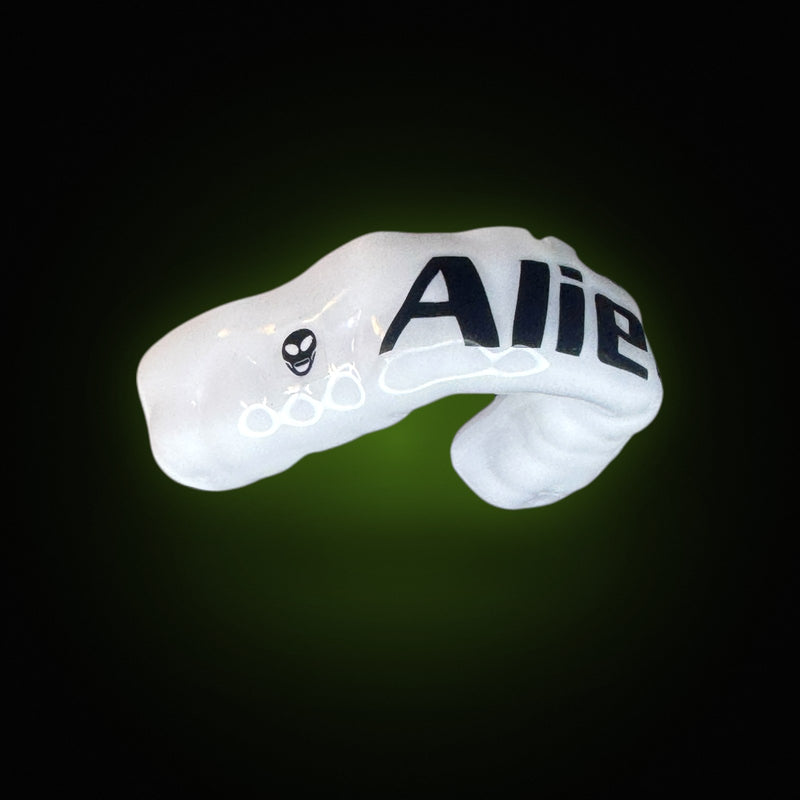
- Let them design it. Kids are prouder of gear they picked: colors, a name, initials or a jersey number. Metallic, satin and holographic text colors are included at no extra charge.
- Make it part of the gear routine. The guard goes in at the first whistle of practice, not just on game day, and lives in a ventilated case in the bag.
- One guard per athlete. Teach your child never to share a mouthguard.
- Model it. If coaches and parents treat the guard as normal gear, kids are more likely to wear it.
Which youth sports require a mouthguard?
According to the AAPD and ADA, the NFHS requires mouthguards in high school football, ice hockey, lacrosse and field hockey, and for wrestlers who wear braces. The AAPD notes that Maine, Massachusetts and New Hampshire have extended requirements to more sports, such as soccer, wrestling and basketball, and youth leagues can add their own rules (for Pop Warner, AYF and NFL FLAG, see youth football mouthguard rules). Junior roller derby skaters need one too under the JRDA edition of the WFTDA rules; see roller derby mouthguard rules. Required or not, the ADA recommends a properly fitted mouthguard for contact and limited-contact sports including basketball, soccer, martial arts, boxing, rugby, volleyball and baseball. See mouthguard rules by sport, and for the diamond, baseball and softball mouthguard rules.
Growing mouths and when to replace
Children's mouths change as baby teeth fall out and adult teeth come in, so a kids custom mouthguard needs a fit check more often than an adult's. The guard still fits if:
- It stays on the upper teeth when they open their mouth, without biting down to hold it.
- It covers all the upper teeth back to the molars and comes up over the front of the teeth toward the gums.
- It has no bite-through spots, tears or thin edges.
- It still fits after a baby tooth falls out or an adult tooth comes in. Check at the start of every season.
If it fails any of these, it is time for a new one. See why a mouthguard falls out, or run the full check in how should a mouthguard fit?
If a tooth gets knocked out
Dental trauma guidelines say a knocked-out baby tooth should not be put back in, but a knocked-out adult tooth should be replanted or stored in milk, and your child should see a dentist right away. Our knocked-out tooth first aid guide covers every step for parents and coaches.
Fun to wear
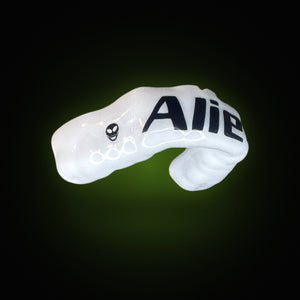
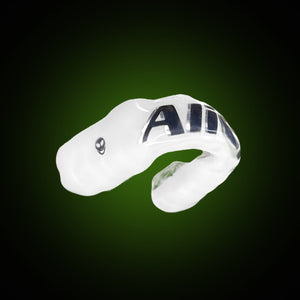
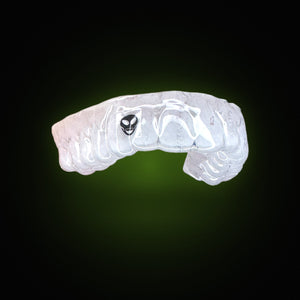
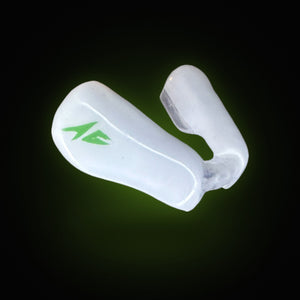
Pick their favorite colors, add their name or number, or put their team's logo on the guard. A name label helps a guard find its way home from practice. More ideas in custom mouthguard designs.
How it works
- Build and order. Pick your model, colors and custom logo or text. We ship you an impression kit.
- Take your impression. Follow the impression guide at home. It takes about 10 minutes and the putty sets in 2 minutes 30 seconds. Then mail the impression back to our lab.
- We make it. Your guard is formed on a plaster model of your bite, pressure-formed from dental-grade material and finished by hand in the USA. It is crafted within 10–14 business days after we receive a good impression, then shipped with tracking. See how long a custom mouthguard takes, start to finish.
It helps to have a parent run the timer and mix the putty, and you can email a photo of the impression to support@alienguards.com before you mail it back so we can confirm it looks good. Your order shows as fulfilled when the finished guard ships, not when the impression kit ships. Accessory-only orders (case, impression kit, putty) ship in a couple of business days.
Care
Rinse it before and after each use, brush it gently with a soft toothbrush, store it in a ventilated case and keep it away from heat. Read more on our blog: Protecting Your Child's Smile, or see how much a custom mouthguard costs. Coaches can order for a whole youth team through team orders; our team and gym mouthguard guide covers planning, impressions and timelines.
Parents: read how a custom mouthguard is made without a dentist, and when to use a dentist impression instead, for example if your child wears braces. If your child says a guard makes it hard to talk, see can you breathe, talk and drink with a mouthguard? For teen athletes, see dental health and sports performance. If your child grinds at night, read teeth grinding and bruxism.
Kids and youth mouthguard FAQ
Is there an age limit?
No. There is no age limit for AlienGuards. Younger athletes' teeth are still changing, so plan to replace their guard more often and check the fit at the start of each season. See how long a custom mouthguard lasts.
Which AlienGuard is best for youth soccer, football or basketball?
NanoBite, our slim 4 mm guard. It is the best of our models for breathing and talking. For boxing, MMA, Muay Thai, kickboxing, karate or taekwondo, choose Origin. Parents comparing school rules can also read football mouthguard rules and hockey mouthguard rules.
Which youth sports require a mouthguard?
The NFHS requires mouthguards in high school football, ice hockey, lacrosse and field hockey, and for wrestlers with braces. Some states and many youth leagues require them in more sports, so check your league's rules. See mouthguard rules by sport.
How do I know when my child needs a new mouthguard?
Replace it if it feels loose, pinches, has to be held in by biting, or has tears or thin spots, and check the fit whenever a baby tooth falls out or an adult tooth comes in. We recommend replacing a mouthguard every year, or sooner if it becomes damaged or worn.
What age should a child start wearing a mouthguard?
Once your child plays a sport with a risk of falls, collisions or contact with a ball, stick or another player. The ADA recommends a properly fitted mouthguard for contact and limited-contact sports at every level, and there is no age limit for AlienGuards. Check the fit each season. For an age-by-age breakdown, see what age kids should start wearing a mouthguard.
Is a custom mouthguard worth it if my child's teeth are still changing?
For many families, yes. The AAPD says custom guards are superior in retention, protection and comfort, and comfort is what keeps kids wearing them. The trade-off is that baby teeth falling out, adult teeth coming in and orthodontic movement can change the fit, so plan on replacing it more often than an adult would.
Is a custom mouthguard better than boil-and-bite for kids?
The AAPD states that custom-fabricated guards are superior in retention, protection and comfort, and that boil-and-bite guards vary greatly in those same areas. A guard that stays in without clenching is easier for a child to wear for a whole game. See why custom mouthguards outperform boil-and-bite.
Can kids with braces get one?
Yes. Athletes with braces can get AlienGuards, but their dentist needs to take the impression instead of using our at-home kit, so the braces don't get damaged. The dentist can take an impression or 3D scan, then ship it to us or email it to impressions@alienguards.com. Young wrestlers with braces should also read wrestling mouthguard rules. Parents can also check mouthguard rules by sport for every sport we cover.
Can I put my child's name or team colors on it?
Yes. NanoBite comes in clear, white or black with up to 3 characters of custom text, such as initials or a number, and Origin can carry colors, a name or a logo. See mouthguard colors to match team uniforms.
Do youth teams get a discount?
Yes. Teams, clubs and schools that order through team orders get 20% off mouthguards and merch, including NanoBite and PowerBite, with a minimum order of 5 mouthguards. See team orders.