

Basketball and Dental Health: Why Mouthguards Matter
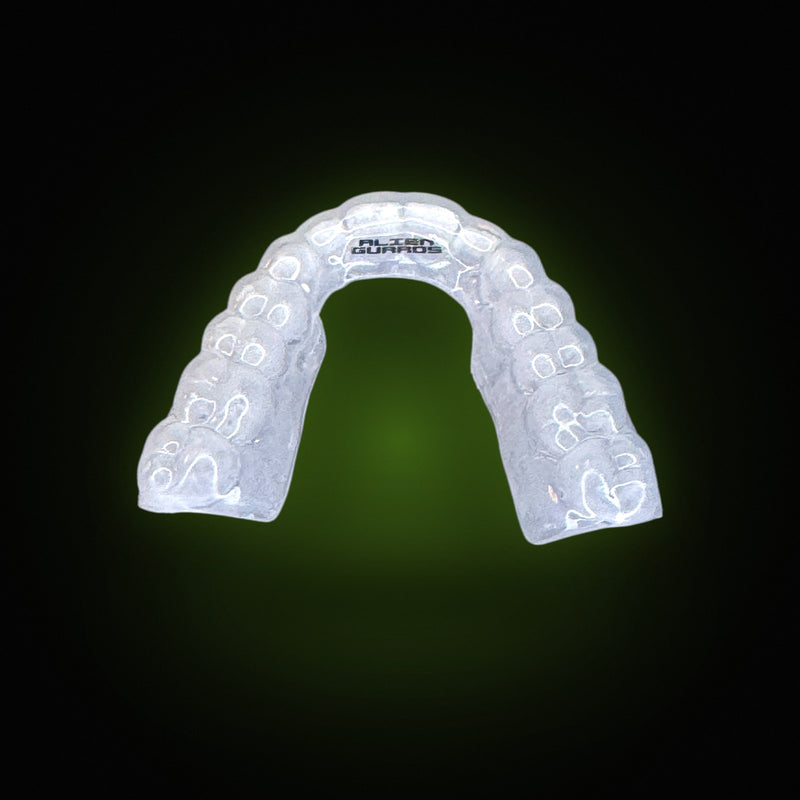
Basketball doesn't look as rough as football or hockey, but it's one of the most common ways athletes damage their teeth. Elbows under the rim, hands swiping at the ball, collisions on drives and falls on a hard floor all reach the face, and players don't wear helmets or face guards. This guide covers what the research says about basketball and dental injuries, what the rulebooks require, what to look for in a basketball mouthguard, and how to get one you'll actually keep in.
Short answer
Yes, basketball is hard on teeth. Most dental injuries on the court come from elbows, heads and hands, and the ADA recommends a properly fitted mouthguard for basketball. National high school and college rules don't require one, but if you wear one in high school it must be custom-fitted or molded. Our pick is NanoBite, our thinnest guard at 4 mm.
Is basketball really a risk to your teeth?
Yes. The American Dental Association (ADA) lists basketball among the contact and collision sports where it recommends a properly fitted mouthguard. It also notes that one study found basketball players had the highest incidence of dental trauma, and that mouthguard use stays low in sports where a governing body doesn't require one. See how basketball compares in mouthguards for contact sports.
The American Academy of Pediatric Dentistry (AAPD) policy on sports-related orofacial injuries says basketball has the highest incidence of sports-related dental injuries for high school boys, at 2.4 per 100,000 athletic exposures. It also notes that basketball dental injuries usually come from player-to-player contact, while most dental injuries in baseball, softball and field hockey come from being hit by an object. In other words, the risk on the court is other players: elbows, heads and hands.
What the research says about mouthguards in basketball
One of the clearest studies comes from college basketball. In a 2002 study by Labella and colleagues, athletic trainers from 50 men's Division I programs reported injuries through the 1999–2000 season, covering 70,936 athlete exposures. Players wearing custom-fitted mouthguards had significantly fewer dental injuries than players without one: 0.12 versus 0.67 per 1,000 athlete exposures. They also had fewer dentist referrals.
The same study found no significant difference in concussions or oral soft tissue injuries between mouthguard users and non-users. That matches the ADA's broader view: the evidence on mouthguards and concussion is mixed, so you should choose a mouthguard to protect your teeth, not to prevent concussions. More in do mouthguards prevent concussions?
Across sports, the ADA summarizes a 2019 systematic review and meta-analysis that found mouthguard users were 82% to 93% less likely to suffer dentofacial injuries than non-users, with broken tooth crowns and knocked-out teeth the most common injuries. That review compared wearers with non-wearers. It doesn't show one brand or type beats another, and no mouthguard prevents every injury.
Face injuries in college and pro basketball
The face takes hits at every level. A 2026 systematic review of 10 studies on college and professional basketball (Mabey and colleagues) found that facial trauma made up 3.9% of NBA injuries, that players had a 12.6% risk of a facial injury per season, and that rates are rising at both levels. About a third of NBA players with a facial injury needed surgery. The authors wrote that many players skip facemasks and mouthguards because of discomfort and league culture. More on why athletes skip it in why every athlete needs a custom mouthguard.
A 2023 study of NBA facial injuries (Sifuentes-Cervantes and colleagues) counted 212 facial injuries in 206 players who missed games. None were in the upper third of the face; 75% were in the middle third and 25% in the lower third, which includes the mouth and jaw. Most were fractures, the nose was the most common break, and centers and power forwards were hurt most often. A mouthguard can't protect the nose or eyes, but it does cover the teeth in the lower face.
Youth players: what surveys show
- Turkey: in a 2025 survey of 125 youth players from 25 teams (Comert and colleagues), 16.8% had a dental injury from basketball, most often a broken tooth. Only 7.2% used a mouthguard, the most common reason was thinking one was unnecessary (41.1%), and only 29.6% knew that putting a knocked-out tooth back quickly improves the outcome.
- Indonesia: in a 2023 study of 286 players (Novrinda and colleagues), 30.1% used a mouthguard. Players were more likely to wear one when they were more aware of the risk, had been injured before, or had support from people around them and from dental professionals.
The takeaway for coaches and parents: support from the people around a player goes with more players wearing a guard. Parents can also read custom mouthguards for kids.
What basketball does to your mouth
- Chipped and broken front teeth: an elbow or head lands a lot of force on a small area, and the upper front teeth take most of it. See how mouthguards protect teeth from chips and cracks.
- Knocked-out teeth: a tooth knocked out of its socket is a dental emergency, and the first few minutes matter most. Coaches and parents should know what to do if a tooth is knocked out.
- Cuts to the lips, cheeks and tongue: without a guard, your own teeth cut the inside of your mouth on contact.
- Jaw impacts: a well-fitted guard helps spread the force of a blow and keeps your teeth from slamming together. See mouthguards and jaw injuries.
Do you have to wear a mouthguard in basketball?
Not under national rules. The NFHS mandates mouthguards in football, field hockey, ice hockey, lacrosse and (for athletes with braces) wrestling, but not basketball. NFHS basketball Rule 3-5-8 recommends a mouthguard, and state associations can make one required. The AAPD notes that Maine, Massachusetts and New Hampshire have extended mouthguard requirements to more sports, including basketball. NCAA basketball rules treat a mouth guard as appropriate equipment rather than mandatory. Ice hockey is a different story; see hockey mouthguard rules.
If you do wear one in high school, it has to be the right kind. The NFHS Basketball Points of Emphasis for 2026–27 say tooth and mouth protectors must be properly designed and worn for protection, that custom-fitted or molded protectors are required, and that decorative or non-protective attachments are prohibited. For the full breakdown, read our basketball mouthguard rules, or see mouthguard rules by sport.
What to look for in a basketball mouthguard
The ADA says an ideal mouthguard is properly fitted, covers the teeth on one arch (usually the upper), stays in place comfortably and securely, and absorbs impact energy. On the court, that means:
- A slim profile you can breathe through. Basketball is constant running. A bulky guard makes it harder to breathe on the break and to call out screens and switches on defense. See can you breathe and talk with a mouthguard?
- It stays in without clenching. A guard you have to bite down on ends up in your hand or your sock during a timeout. If yours slips, read why does my mouthguard fall out?
- The right thickness for the hits you take. Basketball hits are less direct than combat sports. Read how thick should a mouthguard be?
- Nothing extra on it. No charms or decorative attachments, in line with the NFHS points of emphasis.
Why players don't wear one, and how to fix it
The ADA says common reasons athletes skip mouthguards include cost, no requirement and not knowing the benefit. The AAPD adds that players' views on comfort largely decide whether they wear one. If it's bulky, makes you gag or changes how you talk, it ends up in your bag.
That's where fit matters. The ADA describes three types of mouthguards. Stock guards come ready to wear and have to be held in by closing your mouth, so the ADA calls them the least effective. Boil-and-bite guards are shaped by biting into softened plastic, and the ADA warns that imprecise shaping can leave a poor fit. Custom guards are made from an impression of your own teeth for an optimal fit, and one study the ADA cites found them more comfortable and easier to wear. The ADA's key message is that the best mouthguard is the one you actually wear. More in why custom mouthguards outperform boil-and-bite. If you gag easily, see mouthguards and gag reflex. See also which mouthguard material is best.
| Why players skip it | What helps |
|---|---|
| "It's not required" | The ADA still recommends one, and state associations can make one required |
| "It's too bulky to breathe or talk" | A slim custom guard made from your own impression |
| "It falls out" | A guard shaped to your teeth stays in without clenching |
| "My league wants a clear guard" | FIBA rules allow a non-coloured transparent guard; choose Clear and check before adding colored text |
Which AlienGuard for basketball: NanoBite
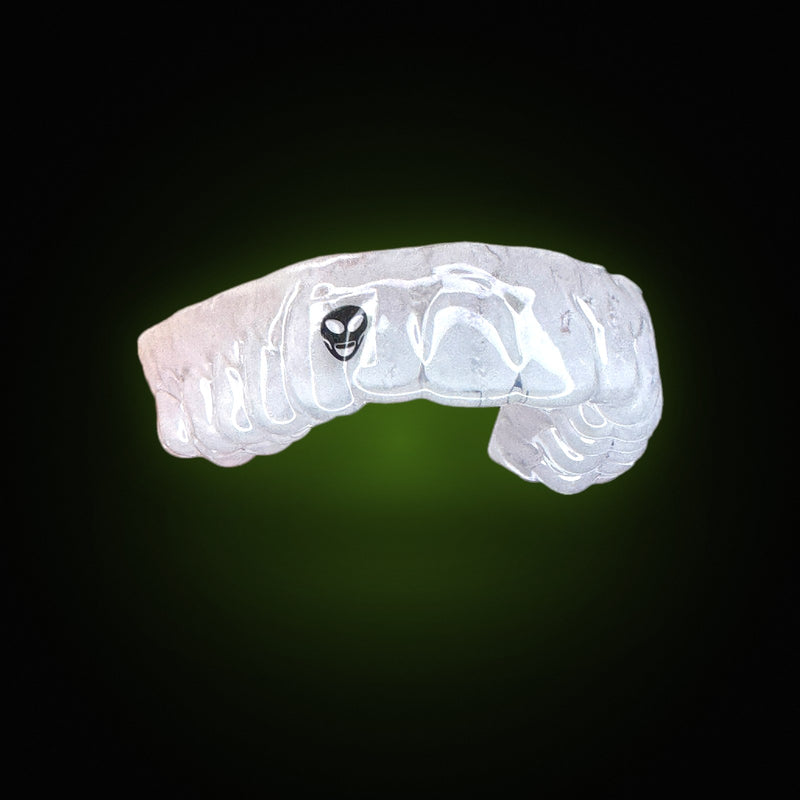
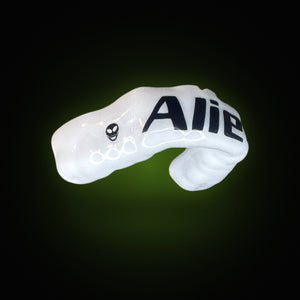
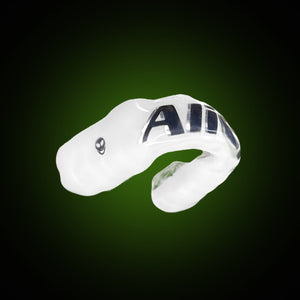
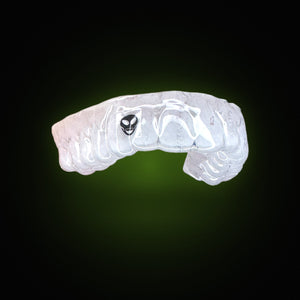
Our pick for basketball is NanoBite, our thinnest guard at 4 mm. It's our lowest-profile model and the best of our guards for breathing and talking, so you can run the floor and still talk on defense.
- Base colors: Clear, White or Black.
- Custom text: up to 3 characters, such as your jersey number or initials, in your team color. Metallic, satin and holographic text colors are free. For ideas, see choosing the right color and design for your mouthguard.
Origin and Origin Pro are our combat guards, made only for boxing, MMA, Muay Thai, kickboxing, karate and taekwondo. They are not our recommendation for basketball. PowerBite is for powerlifting and weightlifting only. To see all four side by side, compare models, shop the basketball collection, or read our basketball mouthguard guide. Also play rugby? See rugby mouthguard rules.
How to order a custom basketball mouthguard
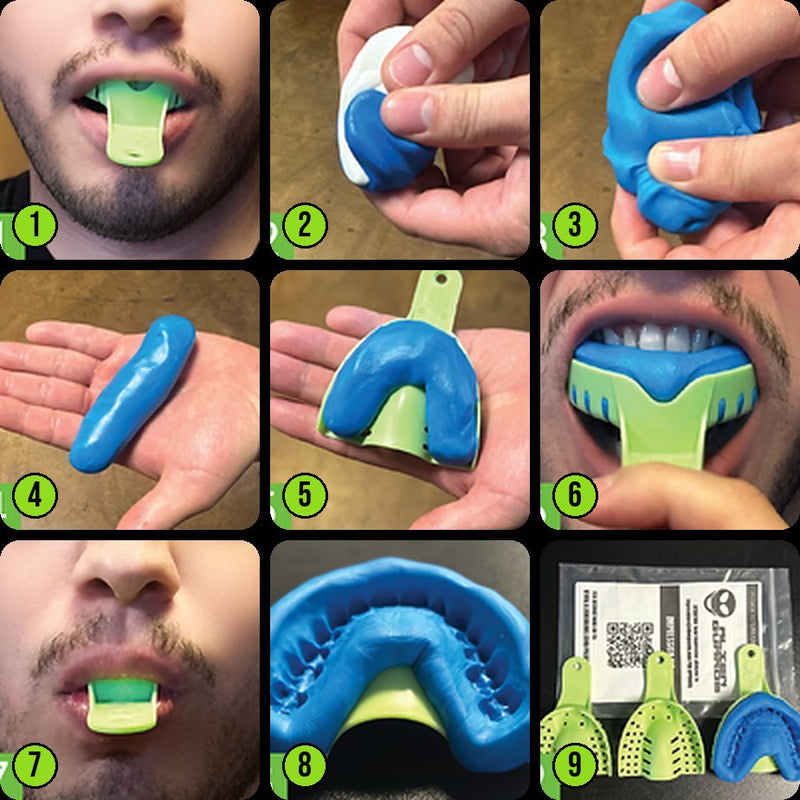
- Build your NanoBite. Pick your base color and custom text, and take a quick smile photo so we can pick your tray size. See sizing and fit.
- Take your impression at home. We ship you an impression kit, and the impression takes about 10 minutes. Follow the impression instructions, then mail it back. Here's how a custom mouthguard is made without a dentist visit.
- We make it. Your guard is crafted within 10–14 business days after we receive a good impression, then shipped with tracking. More in how long a custom mouthguard takes.
Order before tryouts or preseason so the guard feels normal by your first game.
Preseason checklist
- Check your state, league or event handbook for mouthguard rules, including any color rule.
- Get a dental checkup and fix problems before the season starts.
- Order your guard early so it feels normal by the first game.
- Wear it in practice too, not just in games.
- Keep it in a vented case in your bag, and keep it out of your sock.
- Make sure a coach or parent knows knocked-out tooth first aid.
Players with braces
Athletes with braces can get AlienGuards. Your dentist takes the impression or a 3D scan instead of using our at-home kit, so your braces don't get damaged. The dentist can ship it to us or email it to impressions@alienguards.com. More in can you wear a mouthguard with braces?
Youth basketball
There's no age limit, so youth players can order too. Kids' teeth and jaws are still changing, so their guards need checking and replacing more often as they grow. Parents can read our guide to custom mouthguards for kids and youth athletes.
Care and replacement
Rinse your guard in cool water before and after every session, brush it gently with a soft toothbrush and mild soap, and let it air-dry in a vented case. Keep it away from hot water, dishwashers and hot cars so it keeps its shape. See how to clean and care for your custom mouthguard. Replace it every year, or sooner if it's torn, thinned out or loose. More in how often to replace your mouthguard.
Ordering for a whole team
Teams, clubs and schools that order 5 or more mouthguards get 20% off through team orders, including NanoBite, with your team logo plus each player's name or number on every guard. We can also help with on-site fitting (minimum order and location apply) and keep models on file for quick replacements (minimum order; athletes 14+ without braces). See custom mouthguards for gyms and teams. For color and text options, see custom mouthguard designs. Still deciding? See how to choose the right mouthguard for your sport.
Basketball mouthguard FAQ
Do basketball players need mouthguards?
They're not required under national NFHS or NCAA rules, but the ADA recommends a properly fitted mouthguard for basketball, and the AAPD says basketball has the highest rate of sports-related dental injuries for high school boys.
Do mouthguards actually reduce dental injuries in basketball?
In a 2002 study of 50 men's Division I college basketball programs, players wearing custom-fitted mouthguards had significantly fewer dental injuries than players without one (0.12 versus 0.67 per 1,000 athlete exposures).
Does a mouthguard prevent concussions in basketball?
No. The same college basketball study found no significant difference in concussions between mouthguard users and non-users, and the ADA says the evidence on concussion is mixed. Wear a mouthguard to protect your teeth, lips and jaw.
Which AlienGuard is best for basketball?
NanoBite, our thinnest guard at 4 mm and the best of our models for breathing and talking. Origin and Origin Pro are for combat sports only, and PowerBite is for lifting.
Can basketball players with braces get a custom mouthguard?
Yes. Your dentist takes the impression or a 3D scan instead of using our at-home kit, then ships it to us or emails it to impressions@alienguards.com.