
Kickboxing Mouthguards: Choosing a Custom Guard
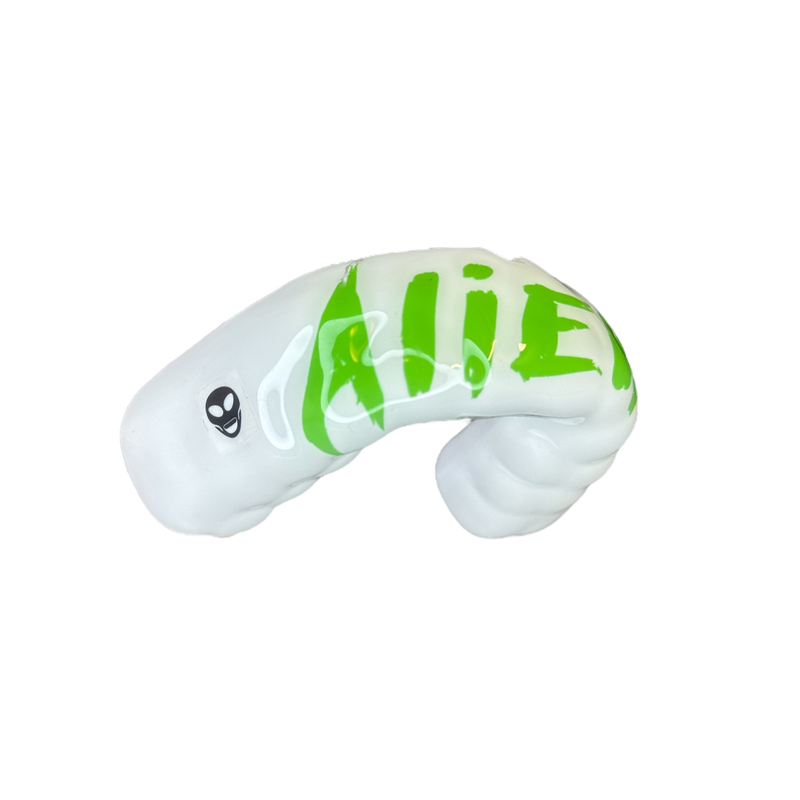
Kickboxing puts punches and kicks in range of your face every round, on the pads, in sparring and in the ring. A mouthguard is part of your kit from the first sparring class. This guide covers how to choose a kickboxing mouthguard, which AlienGuard we recommend, and how gyms order. To shop directly, see our combat sports mouthguards. For jaw pain or clicking, see mouthguards and TMJ disorders.
Kickboxing mouthguard rules at a glance
- WAKO (international amateur): tooth protection is mandatory in every fighting discipline and every age category. The guard must fit your mouth, allow free breathing and not stick out of the mouth, and it can be any color. The central referee checks it before the bout, and it does not need a WAKO label.
- ISKA amateur: K-1, Unified Rules and Muay Thai amateur rules list an individually fitted mouth guard (gum shield) as protective equipment.
- GLORY (professional): every athlete must wear a mouthguard approved by GLORY or the Regulator, and the corner must bring a spare.
- Spitting it out: deliberately spitting out your guard is a foul under WAKO and GLORY rules, with warnings and point deductions.
- Braces: WAKO requires a dentist's certificate, and upper and lower guards if the lower teeth have braces.
Commissions, local shows and gyms can add their own rules, so check the fact sheet before weigh-ins. Rule numbers and sources are in kickboxing mouthguard rules.
What the rule books say in more detail
WAKO. The WAKO Equipment Book (Article 1.3.3) and the WAKO Rules (Article 2.3.1.3) make tooth protection mandatory for all fighting disciplines in all age categories. The guard should be soft and pliable rubber-plastic or silicone, can cover only the upper teeth or both upper and lower, must allow free breathing, must be adapted to your mouth and must not protrude outside the mouth in any way. The Equipment Book lists the mouth guard among the items that need no WAKO label, so a custom guard is fine. Under Article 2.1.4.1 the central referee checks the mouth guards before the bout. A kickboxer who comes to the ring without one is not disqualified straight away: they get two minutes to fix the problem, and if they are still not ready they are disqualified and the result goes down as a walkover (Article 2.3.4).
ISKA. The ISKA amateur rulebook (January 2025) lists an "Individually fitted Mouth Guard (gum shield)" in the protective equipment for its K-1, Unified Rules and Muay Thai ring sports, alongside a head guard with no visors or faceguards, 10 oz boxing gloves and groin or breast protection. Pro and regional ISKA events publish their own mouthpiece language.
GLORY. The GLORY rules (March 2026) require every athlete to wear a mouthguard approved by GLORY or the Regulator during the match (Rule 4.01(E)), require cornermen to bring one extra mouthguard to the corner (Rule 4.05(D)) and list spitting it out as a match foul (Rule 5.07).
Spitting it out. Under the WAKO full-contact foul language, if a kickboxer voluntarily spits out the mouth guard, the central referee stops the fight and gives an official warning the first time and a minus point the second time. GLORY also lists deliberate spitting out under unsportsmanlike conduct, and ISKA Thailand's rules allow point deductions if a mouthpiece is intentionally dislodged. A guard that pops out in sparring is usually a fit problem; read why a mouthguard falls out before fight night.
Not school sports. Kickboxing is not on the NFHS school mouthguard-mandate list. Competition kickboxing follows WAKO, ISKA, GLORY, commission or local rules, so check your sanctioning body, promoter fact sheet or coach's gear list before weigh-ins.
What the research says about kickboxing mouth injuries
- Professional bouts: a 16-year study of professional kickboxers in Victoria, Australia recorded 382 injuries in 3,481 fight participations. The head, neck and face accounted for 52.5% of injuries, and most were bruises or cuts.
- Mouthguard users vs none: in a 2025 survey of 92 UK kickboxers in the British Dental Journal, 71.7% had had at least one injury to the face or jaw, most often to the lip. Injuries per participant were 2.6 among mouthguard users and 4.7 with no protection.
- Amateur athletes: in a 2024 survey of 142 Italian amateur kickboxers, 13% had a dental injury while training or fighting. 68% used a mouthguard, and 74% of those guards came from a sports shop.
- Training vs fights: a 2025 Swiss survey of 419 Muay Thai, K-1 and kickboxing athletes found leg injuries were most common in training, while head injuries were most common in competition. 75% wore a mouthguard in training, but only 11.5% wore a professionally made one.
- Across combat sports: a 2020 meta-analysis that included kickboxing put the pooled rate of dentofacial injuries at about 30%.
These are mostly surveys, so they show associations rather than proof of cause. A mouthguard protects teeth, lips and cheeks; it does not stop every facial injury and has not been proven to prevent concussions (see do mouthguards prevent concussions?). Wear it in sparring as well as on fight night.
Fight-day mouthguard checklist
- Bring two. GLORY requires a spare in the corner, and it is a good habit at any event.
- Check the event's color rule. WAKO allows any color; IFMA Muay Thai events do not allow red or pink.
- Have it in before you step through the ropes. At WAKO events the central referee checks it.
- Spar in your fight guard so you know it stays in when you check kicks and clinch. See the best mouthguard for sparring.
- Bring your brace certificate to WAKO events if you wear braces.
- Know the first steps if a tooth comes out. Read knocked-out tooth first aid.
Stock, boil-and-bite or custom?
Stock guards are pre-formed and offer basic protection. Boil-and-bite guards are softened in hot water and bitten into for a closer fit. Custom-fit guards, like AlienGuards, are made from an impression of your own teeth, so there is no size chart and no guessing. A custom guard is more comfortable and secure than a store-bought guard, does not slip or fall out, and is easier to keep in through long sparring sessions. More in our guide to the best mouthguard for sparring. Custom guards usually cost more than over-the-counter options. You are paying for that fit, comfort and durability. More on the difference: why custom mouthguards outperform boil-and-bite. For how strikes affect your teeth, lips and jaw, see combat sports and dental protection.
Best mouthguard for kickboxing: Origin
Origin is our combat guard for boxing, MMA, Muay Thai, kickboxing, karate and taekwondo. It has reinforced impact zones and is 5 mm thick, the industry standard for competitive combat sports. Combat guards are 5 mm, compared with 4 mm for non-combat sports, because the extra material absorbs more force from direct strikes. What that can and can't mean for your jaw: mouthguards and jaw injuries.
Origin Pro: more breathable and comfortable
Origin Pro, our premium combat guard, has the same 5 mm protection as Origin, with more breathability and comfort, plus an optional High Impact 6mm upgrade for super high-impact training and fights. Compare both on the model comparison, or read how thick a mouthguard should be.
Kickboxing, Muay Thai or boxing?
All three are combat sports with direct strikes, so we recommend the same guards for each: Origin or Origin Pro. If you also train Muay Thai, see our Muay Thai mouthguard guide. IFMA gum-shield requirements are in our Muay Thai mouthguard rules. WAKO tooth-protection language is in our kickboxing mouthguard rules. If you box, see custom boxing mouthguards. Cross-training in MMA? Read boxing vs. MMA mouthguards or shop our MMA mouthguards. Commission MMA mouthpiece rules are in our MMA mouthguard rules guide. Training karate or taekwondo too? See our karate and taekwondo mouthguard guide. WKF and WT requirements are in our karate and taekwondo mouthguard rules. For every sport in one place, see mouthguard rules by sport.
Grappling or lifting too?
If you also train jiu-jitsu or wrestling, NanoBite is our ultra-slim, 4 mm, low-profile guard for grappling and team sports. See the MMA and BJJ mouthguard guide. For powerlifting and weightlifting, PowerBite is our lifting guard.
Make it yours
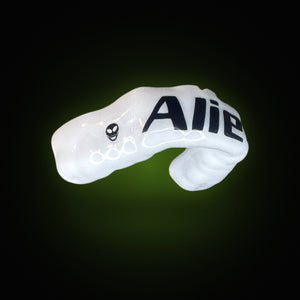
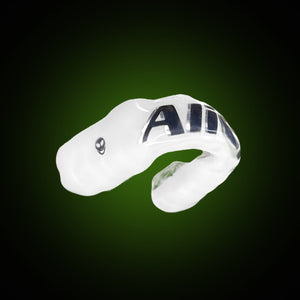
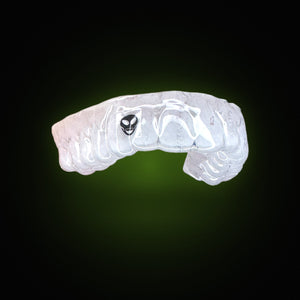
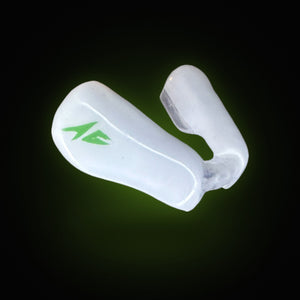
Origin and Origin Pro can carry colors, text, a logo or full custom art. Add your name or your gym's logo, and add Impression Storage so you can reorder without taking a new impression. See real guards from our lab on Our Designs. For ideas, read choosing the right color and design and the aesthetic appeal of custom mouthguards.
Braces, kids and youth kickboxers
Every order requires a liability waiver. Athletes with braces can get AlienGuards, but their dentist needs to take the impression instead of using our at-home kit, so the braces don't get damaged. Your dentist can take an impression or 3D scan, then ship it to us or email it to impressions@alienguards.com. Under WAKO competition rules, a mouth-guard over braces or retainers is not allowed unless a dentist's certificate allows it, and any kickboxer with a dental brace must provide a WAKO Dental Brace Certificate from their orthodontic surgeon. If you have braces on the lower teeth or on both upper and lower teeth, WAKO says you must have a mouth-guard on both upper and lower teeth. Bring the paperwork your federation requires: our lab work does not replace WAKO's medical or equipment forms. How MMA, boxing, karate and taekwondo rule books handle braces is in mouthguard rules with braces, sport by sport. There is no age limit, but younger athletes' teeth are still changing, so plan to replace their guard more often. Parents can read our guide to custom mouthguards for kids and youth athletes and what age kids should start wearing a mouthguard.
Kickboxing gyms and teams
Gyms, fight teams and schools can order through the team orders:
- 20% off mouthguards and merch (all models, including NanoBite and PowerBite), with a minimum order of 5 mouthguards.
- Your gym logo plus athlete names or numbers on every guard.
- On-site fitting to help every athlete take a good impression (minimum order and location apply).
- Models kept on file for quick replacements (minimum order; athletes 14+ without braces).
More on team programs: custom mouthguards for gyms and teams. Gyms that want to stock and resell guards to their members can apply to our wholesale and partnership program.
How ordering works
- Build and order. Pick your model, colors and custom logo or text. We ship you an impression kit.
- Take your impression. Follow the impression guide at home. It takes about 10 minutes, and the putty sets in 2 minutes 30 seconds. Then mail the impression back to our lab.
- We make it. Your guard is formed on a model of your bite, pressure-formed from dental-grade material and finished by hand in the USA. It is crafted within 10–14 business days after we receive a good impression, then shipped with tracking. The full timeline is in how long a custom mouthguard takes.
Your order shows as fulfilled when the finished guard ships, not when the impression kit ships. Accessory-only orders (case, impression kit, putty) ship in a couple of business days. Origin and Origin Pro both offer Expedited Lab Service when you need a tighter timeline before a bout.
New to custom guards? Read how a custom mouthguard is made without a dentist, step by step. What to do if you chip a tooth: chipped and cracked teeth in sports. If a tooth is knocked out, see knocked-out tooth first aid. For what a guard can and can't do for your head, see do mouthguards prevent concussions?
Kickboxing mouthguard FAQ
What is the best mouthguard for kickboxing?
Our pick is Origin, our combat guard with reinforced impact zones and 5 mm thickness. Choose Origin Pro for the same 5 mm protection with more breathability and comfort, and the optional High Impact 6mm upgrade.
Is a mouthguard required in kickboxing?
Yes, under WAKO rules tooth protection is mandatory in every fighting discipline and age category, and GLORY requires an approved mouthguard in professional bouts. ISKA amateur rules list an individually fitted mouth guard as protective equipment. See kickboxing mouthguard rules.
What color mouthguard can I wear in kickboxing?
WAKO allows a mouthguard of any color. Other promotions and commissions can set their own rules, so check your event's equipment sheet before fight day.
What happens if I spit out my mouthguard in kickboxing?
Under WAKO, voluntarily spitting out the mouth guard draws an official warning the first time and a minus point the second time. GLORY lists spitting it out as a foul, and ISKA Thailand's rules allow point deductions for intentional dislodging. A custom guard that fits your bite is less likely to come out in the first place.
What if I arrive at a WAKO event without a mouthguard?
You are not disqualified straight away. Under WAKO Article 2.3.4 you get two minutes to fix the problem, and if you are still not ready you are disqualified and the result is a walkover. The central referee checks mouth guards before each bout, so bring a spare.
Can I wear one with braces?
Yes. Your dentist needs to take your impression instead of using our at-home kit, so your braces don't get damaged. Your dentist can take an impression or 3D scan, then ship it to us or email it to impressions@alienguards.com.
Is there an age limit?
No. Younger athletes' teeth are still changing, so plan to replace their guard more often.
Do kickboxing gyms get a discount?
Yes. Gyms and teams that order through the team orders get 20% off mouthguards and merch, including NanoBite and PowerBite, with a minimum order of 5 mouthguards.
How often should I replace it?
We recommend every year, or sooner if it is damaged or worn. See how often to replace your mouthguard.
More answers are in the FAQ.