

How Often Should You Replace Your Mouthguard?
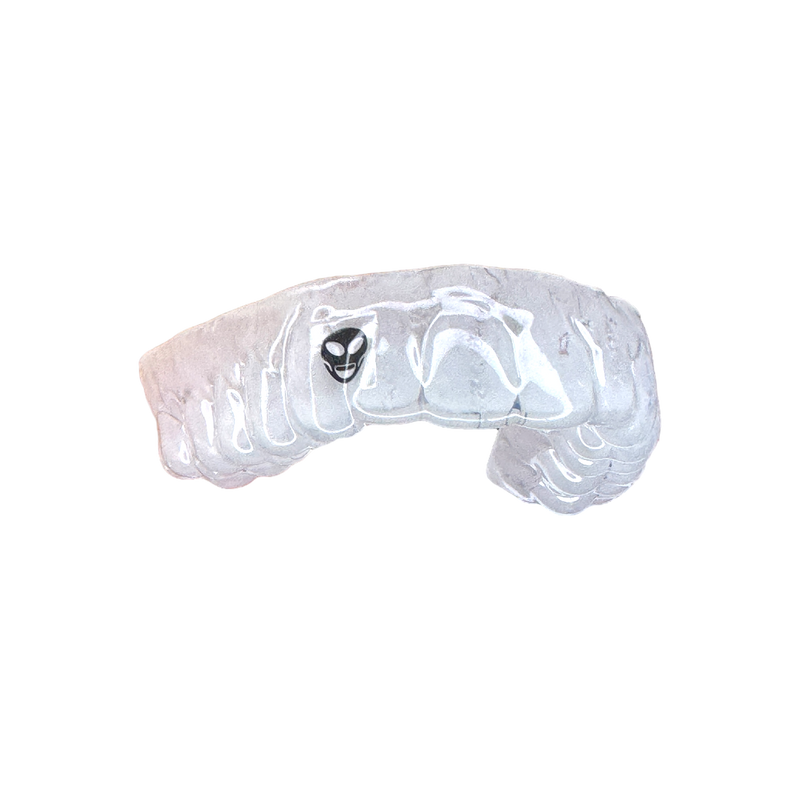
A mouthguard only protects you if it still fits and is still in one piece. Even a custom guard wears over time, and young athletes' mouths keep changing. This guide covers how often to replace your mouthguard, what studies show happens to guards during a season, the signs it's time, a simple check you can do yourself, and how to get a new one without starting from scratch. It's based on guidance from the American Dental Association's MouthHealthy site, the ADA's guidance on athletic mouth protectors, published studies and our own lab.
The short answer
We recommend replacing your mouthguard every year, or sooner if it's damaged, worn or no longer fits. That is our standard for every AlienGuard. Kids and teens may need a new one sooner, because their teeth are still changing. To check your fit, see how a custom fit helps you play, or use the 60-second check in how should a mouthguard fit?
The ADA's MouthHealthy site says to talk to your dentist about when to replace your mouthguard, but to replace it immediately if it shows signs of wear, is damaged or is ill-fitting. It also notes that teens and children may need to replace their mouthguards more often because their mouths are still growing and changing.
What happens to a guard during a season
A guard that looks fine can still be changing. A few studies show how:
- It gets thinner and changes shape. In a 2007 study of high school varsity football players (Del Rossi and colleagues), custom guards were measured before, during and after the season. After six weeks, material at the front teeth had thinned by about 16% and at the molars by 23%, and the guards' shape had changed. Four of the 15 players lost their guards before the season ended. The authors advised frequent inspections to make sure fit and protection haven't been compromised. High school football rules say the same: a guard that's been chewed or altered so it no longer protects must be replaced (see our football mouthguard guide).
- Hits wear it down. In a 2024 lab test (Arfi and colleagues), thermoformed EVA guards lost an average of 2.2 mm of thickness at the impact zone after five impacts.
- The surface gets rougher and holds more bacteria. A 2025 study of guards from junior football players under 12 (Badari and colleagues) found used guards had much rougher surfaces than new ones, and electron microscopy showed about eight times more bacteria on the worn surfaces. In a 2021 randomized trial of young martial artists (Ribeiro and colleagues), guards were heavily contaminated and their surfaces rougher after just two weeks of use.
- Sharp edges are a signal. A 2011 study of 81 guards from Division I football players (Glass and colleagues) found bacteria, yeasts and molds on used guards and advised that guards be sanitized daily and changed when they become sharp or jagged.
No study has set an exact lifespan for a sports mouthguard, and how fast a guard wears depends on your sport, how often you train and whether you chew on it. That's why we pair a yearly replacement with regular checks.
What lab aging tests show
Researchers also age mouthguard material in the lab to see how it changes. In a 2024 study in Dental Traumatology (Costa and colleagues), samples of four EVA sheet brands used for custom guards went through 10,000 cycles between cold (5°C) and warm (55°C) water. The material got noticeably softer: its stiffness dropped by roughly a quarter to a third, depending on the brand. In the authors' computer model of a 3 mm guard, the aged, softer material actually absorbed more shock.
So temperature cycling on its own doesn't seem to wreck a guard's cushioning. The changes that matter most are the ones in the section above: material wearing thin where you bite and get hit, the guard changing shape, rough surfaces that hold bacteria, and a fit that loosens. Those are what the two-minute check below looks for.
Why condition matters for protection
Mouthguards work. A 2019 systematic review and meta-analysis (Fernandes and colleagues) of contact-sport athletes found dental trauma in about 7.5% to 7.75% of mouthguard users, compared with about 48% to 59% of non-users. But that benefit assumes a guard that fits and is actually worn. The ADA's guidance describes an ideal mouthguard as one that is properly fitted to the wearer's mouth, stays in place comfortably and securely, is relatively easy to clean, and absorbs impact energy well to reduce the force passed on to the teeth. A guard that has thinned, warped or loosened is drifting away from each of those.
A worn guard also tends to end up out of your mouth. If it rubs, rocks or feels bulky, athletes take it out between plays or leave it in the bag, and a guard that isn't in your mouth can't protect anything. Replacing it on schedule keeps it comfortable enough to wear for every session. A mouthguard also doesn't prevent every injury, so replacing it is about keeping the protection it does give you. If a guard makes you gag, read mouthguard gag reflex causes and fixes.
When to replace a sports mouthguard: 7 signs it's time
- It's damaged. Cracks, tears, chewed edges or spots that look thinner than the rest mean there is less material where you need it.
- It has sharp or jagged edges. Rough edges can rub your gums and cheeks, and a rough surface is harder to keep clean.
- It doesn't fit like it used to. A custom guard should stay put without you clenching to hold it in. If it feels loose, rocks or falls out, it's no longer doing its job. See why a mouthguard falls out.
- It has changed shape. Heat from hot water, a dishwasher, a hot car or direct sun can warp a guard. MouthHealthy says never to leave a guard in the sun or in hot water. Once the shape is off, so is the fit.
- It smells or looks cloudy even after cleaning. If a deep clean doesn't fix it, replace it.
- Your teeth have changed. Growth, braces, new dental work or a lost tooth can all change how a guard sits. If a tooth was knocked out, start with knocked-out tooth first aid and ask your dentist before you reorder.
- It's been about a year. Even if it looks fine, a year of regular use is our point to replace it.
A two-minute check
Once a month, and at the start of every season, look your guard over in good light:
- Put it in. Does it snap into place and stay there without you biting down to hold it?
- Run a finger around the edges. Any cracks, tears, chewed spots or sharp areas?
- Look at the biting surface and the front. Is it worn thin or flattened anywhere?
- Hold it up to the light. Has it warped, twisted or lost its shape?
- Smell it after cleaning. Does an odor stay even after a deep clean?
If anything fails, replace it. MouthHealthy also suggests bringing your mouthguard to your regular dental checkups so your dentist can look at it.
Kids and youth athletes
There is no age limit for AlienGuards. Younger athletes' teeth are still changing, so plan to replace their guard more often than an adult's, and check the fit at the start of each season. A guard that fit last year may not fit now. Kids also lose guards: in a 2008 study of children given mouthguards (Matalon and colleagues), younger children were more likely to lose theirs. A labeled case in the same pocket of the sports bag helps.
Our parent's guide to kids' mouthguards explains how growing teeth affect fit, and what age kids should wear a mouthguard covers when to start. See custom mouthguards for kids and youth athletes.
Braces and dental work
Athletes with braces can get AlienGuards, but their dentist needs to take the impression instead of using our at-home kit, so the braces don't get damaged. Your dentist can take an impression or 3D scan, then ship it to us or email it to impressions@alienguards.com. MouthHealthy notes that a properly fitted mouthguard may be especially important for people who wear braces, because a blow to the face could damage brackets and the guard puts a barrier between the braces and your cheeks and lips. Because braces move teeth, a guard made earlier may stop fitting. If teeth have moved or you've had dental work since your last impression, contact us before reordering from a stored model. For crowns, bridges, implants and veneers, see mouthguards with dental work. Read more in can you wear a mouthguard with braces?
Habits that wear a guard out early
Most athletes don't look after their guards as well as they think. In a 2026 survey of 214 youth ice hockey players in Ontario (Jang and Singhal), about 47% wore their guard in both games and practices, 52% said they cleaned it, and only 38% of those cleaned it after every game or practice. Among custom guard users, 64% said a dentist had never given them care instructions. In a 2025 study of 394 athletes (Özkal Eminoğlu and colleagues), combat-sport athletes cleaned and stored their guards more carefully than team-sport athletes.
The habits that shorten a guard's life, or make it less hygienic, are simple to fix:
- Chewing on it between plays or rounds, which thins and tears the edges.
- Tossing it loose into the bag, where it gets crushed or picks up dirt.
- Sealing it in a case while it's still wet.
- Leaving the bag in a hot car or in the sun.
- Sharing it, or letting a teammate "try it on".
Mouthguard replacement schedule by athlete
Use this as a sports mouthguard replacement schedule. The check is the two-minute check above.
| Athlete | When to check | When to replace |
|---|---|---|
| Adult team-sport or grappling athlete | Start of each season, then monthly | Every year, or sooner if it fails the check |
| Combat athlete in a fight camp | Start of camp and fight week | Every year, or sooner with heavy sparring wear |
| Growing kid or teen | Start of each season | As soon as it feels loose or tight |
| Athlete with braces | Whenever your orthodontist adjusts or changes appliances | When it stops fitting, and after braces come off |
| After dental work or a dental injury | Before your next session | If your dentist says the fit has changed |
Fighters, check the spare too. Nevada's unified rules (NRUC 2.040) require the chief second to carry one extra mouthpiece, and GLORY kickboxing rules (4.05(D)) also have the corner bring an extra. A spare only helps if it also fits and passes the same check, so replace it on the same schedule as your main guard.
How to make your mouthguard last
- Rinse it in cool water before and after each use.
- Brush it gently with a soft toothbrush and mild soap, not toothpaste, which can scratch and dull the guard.
- Let it air-dry and store it in a ventilated case.
- Keep it away from heat: hot water, dishwashers, hot cars and direct sun.
- Skip mouthwash, alcohol and bleach.
- Don't chew on it, and keep it away from pets.
The full routine is in our mouthguard care guide, and the durability of custom mouthguards explains what makes a guard last. For how thickness changes with use, see how thick a mouthguard should be. Packing a full kit? See why every athlete needs a custom mouthguard. Seeing grinding wear on your teeth? See teeth grinding and bruxism.
Replacing an AlienGuard
- With Impression Storage: add Impression Storage when you build and we keep your model on file. You get 20% off future reorders, and you can reorder without taking a new impression, as long as your teeth haven't changed.
- Without a stored model: build a new guard and we ship you an at-home impression kit, the same as your first order. Follow the impression guide. Your guard is crafted within 10–14 business days after we receive a good impression, then shipped with tracking.
- Teams and gyms: with team orders we keep athletes' models on file for quick replacements (minimum order; athletes 14 and over without braces).
Normal wear over time is expected and isn't a fit problem. If a new guard doesn't fit properly, our refund and remake policy covers a free remake first. Ordering a new one? For color and text ideas, see custom mouthguard designs. Hockey players can find more in our guide to mouthguards for hockey players.
Which guard to reorder
- Origin and Origin Pro: 5 mm combat guards for boxing, MMA, Muay Thai, kickboxing, karate and taekwondo. Boxers can check boxing mouthguard rules.
- NanoBite: our thinnest guard, at 4 mm, for wrestling, BJJ, football, rugby, lacrosse, hockey, field hockey, basketball, soccer and other team sports. Playing field hockey? See field hockey mouthguard rules. Grapplers can check BJJ mouthguard rules. Rugby players: see how rugby players can protect their smile. Basketball and ice hockey players can check basketball mouthguard rules and hockey mouthguard rules.
- PowerBite: powerlifting and weightlifting.
Not sure? Compare our models or visit our help center.
Mouthguard replacement FAQ
When should you replace a sports mouthguard?
Replace it right away if it is cracked, torn, chewed or worn thin, has sharp edges, has warped, feels loose or still smells after a deep clean, and whenever your teeth change from growth, braces, dental work or a lost tooth. Otherwise, replace it about once a year, even if it looks fine. Check it at the start of each season and once a month. The signs and a replacement schedule by athlete are above.
How often should you replace a mouthguard?
We recommend every year, or sooner if it's damaged, worn or no longer fits. A guard warped by heat no longer fits and should be replaced.
How often should kids replace their mouthguard?
More often than adults. Their teeth are still changing, so check the fit each season and replace the guard when it gets loose or tight.
Can I reorder without a new impression?
Yes, if you chose Impression Storage when you built your guard and your teeth haven't changed since. Impression Storage also gives you 20% off future reorders.
Should I get a new mouthguard after braces?
Yes. Braces move teeth, so a guard made before or during treatment may not fit afterwards. While braces are on, your dentist takes the impression or 3D scan instead of our at-home kit.
Is normal wear covered by the remake policy?
No. Normal wear over time isn't a fit problem, which is why we recommend replacing your guard every year. A guard that doesn't fit properly when it arrives is covered by our refund and remake policy.