

Mouthguards With Crowns, Bridges, Implants and Veneers
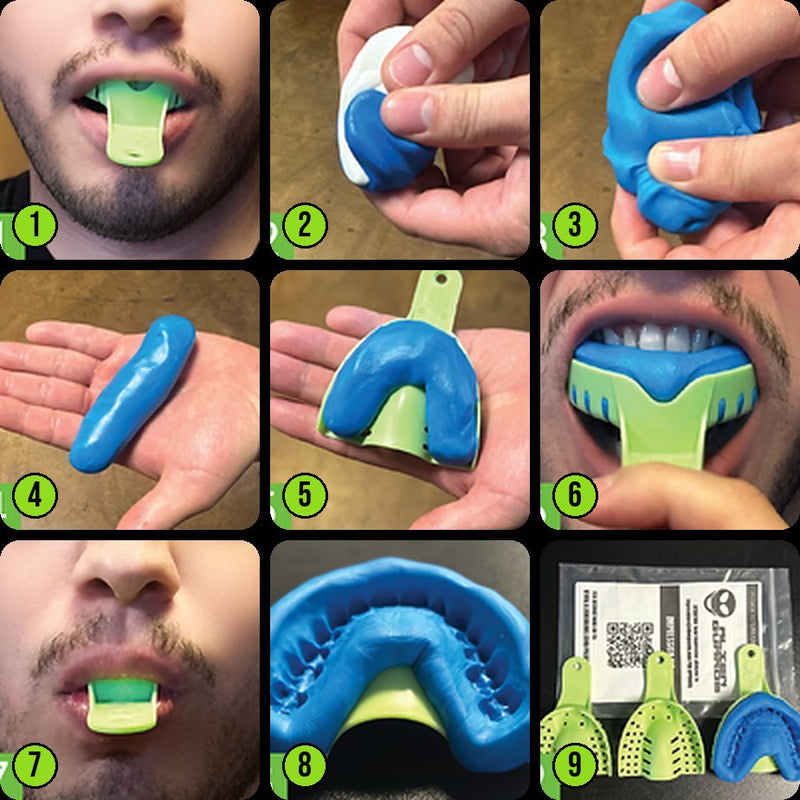
If you've paid for a crown, a bridge, an implant or a set of veneers, you have more riding on your front teeth than most athletes. A ball, an elbow or a fall can chip a veneer or crack a crown. A mouthguard is still the basic protection, but dental work raises practical points: how the guard is made, whether you can take the impression at home, and what to do about a partial denture or missing teeth.
This guide sums up what the American Dental Association (ADA), the American College of Prosthodontists (ACP), the American Academy of Pediatric Dentistry (AAPD) and published lab studies say. It's general information, not dental advice. For anything recent, loose, temporary or removable, your dentist's advice comes first.
The short answer
- Yes, you should still wear a mouthguard with dental work. The ADA recommends a properly fitted mouthguard for sports with a real risk of dental injury, and it notes that the ACP and AAPD recommend mouthguards for contact and collision sports too.
- Crowns, bridges and veneers: a guard covers them like natural teeth. MouthHealthy says a properly fitted guard may be especially important for people with fixed bridge work, and its veneer care advice includes wearing a mouthguard for sports.
- Implants: lab studies show a mouthguard absorbed a large share of impact energy on an implant model. Ask your dentist when the implant is healed enough for contact sport and for an impression.
- Missing teeth and partial dentures: a custom guard can be shaped around gaps. Whether to wear a removable partial during sport, and whether the guard is made with it in or out, is your dentist's call.
- Recent or loose work: don't use an at-home impression kit over dental work that hasn't healed, or over loose teeth, crowns or bridges. Talk to your dentist first.
Why dental work is worth protecting
Most sports mouth injuries hit the front of the upper jaw. The AAPD sports injury policy says 50% to 90% of dental injuries involve the upper front teeth (maxillary incisors), and that crown fractures are the most common injury to permanent teeth. Those are often the same teeth that end up with veneers, crowns or bonding.
The AAPD also points out that costs can build up over a lifetime for restorative, endodontic, prosthodontic, implant or surgical treatment after a tooth injury. The ACP position statement on mouthguard use in sports makes the same point from the prosthodontist's side: the benefits of a custom mouthguard "far exceed the expenditure when considering the fees and discomfort associated with a traumatic dental injury and subsequent prosthodontic treatment."
Restorations don't make a tooth injury-proof. MouthHealthy's veneers page says a veneer may chip, crack, wear down or loosen over time and need to be re-bonded, repaired or replaced, and its care list includes "Wear a mouthguard if you play a sport or do an activity that could injure your mouth." Its crowns page explains that crowns are often placed to protect a weak tooth from breaking or to restore one that's already broken. For the basics of how guards prevent chips and fractures, see how mouthguards protect your teeth from chips and cracks.
What the dental groups say
Here is what each group actually says:
- ADA: the ADA athletic mouth protectors page recommends a properly fitted mouthguard to reduce the incidence and severity of oral injury in sporting or recreational activities, and says an ideal guard should "cover all remaining teeth on one arch, customarily the maxillary." The word "remaining" matters if you're missing teeth: the guard covers what you have.
- ADA MouthHealthy: the MouthHealthy mouthguard page says a properly fitted mouthguard "may be especially important for people who wear braces or have fixed bridge work," and that if you have a retainer or other removable appliance, you shouldn't wear it during contact sports.
- ACP: the prosthodontists' statement supports mouthguards for all contact sports, recommends custom-made guards, and says guards are also indicated for people missing some teeth (more below).
- AAPD: quoting the original purpose of the mouthguard, the AAPD lists protecting the teeth from crown fractures, root fractures, luxations and avulsions, protecting the jaw, and providing "support for edentulous space."
Mouthguards with crowns
A crown is a cap that covers the whole visible part of a tooth. MouthHealthy says crowns are used to strengthen a tooth with a large filling, attach bridges, protect a weak tooth, restore a broken one, cover discolored or badly shaped teeth, and cover a dental implant.
From a mouthguard's point of view, a crown that's firmly cemented is part of the shape of your mouth. A custom guard is formed on a model of your own teeth, so it fits around the crown the same way it fits around your natural teeth. The goals are the same as for any guard: cover the upper teeth back to the molars, sit snugly without biting to hold it in, and spread a hit across the arch instead of letting one tooth take it. Our guide to how a mouthguard should fit walks through the checks.
Two things to watch with crowns:
- Temporary crowns. MouthHealthy's implants page notes that your dentist may give you a temporary crown, bridge or denture while the permanent one is being made. A temporary is meant to be replaced, and the final crown may not be exactly the same shape. Ask your dentist before pressing impression putty over a temporary, and plan on taking your impression after the final crown is placed.
- A crown that feels loose. Our impression kit safety page says not to use the at-home kit, and to talk to a dentist first, if you have loose teeth or loose crowns or bridges. A loose crown is a dentist visit first and a mouthguard second.
Mouthguards with bridges
MouthHealthy's bridges page describes a bridge (sometimes called a fixed partial denture) as artificial teeth that "bridge" the gap left by missing teeth, attached to the surrounding teeth for support. A fixed bridge can only be removed by a dentist, while a removable bridge can be taken out to clean. An implant bridge attaches the artificial teeth to implants instead of natural teeth.
A fixed bridge is one of the cases MouthHealthy singles out: it says a properly fitted mouthguard may be especially important for people with fixed bridge work. Because a bridge is attached to the teeth beside the gap, a hit to it involves more than one tooth. As with crowns, a custom guard made from an impression of your teeth with the bridge in place fits around it.
A removable bridge is different. It's a removable appliance, and MouthHealthy's advice is not to wear a removable appliance during contact sports. If yours is removable, ask your dentist whether it should come out for sport and whether your guard should be made with it in or out (see partial dentures below).
Mouthguards with dental implants
A dental implant is a post placed in the jawbone that anchors a crown, bridge or denture. MouthHealthy's implants page explains that the bone grows around the implant in a process called osseointegration, which "takes time," and that some patients wait until the implant is fully integrated, up to several months, before the replacement teeth are attached.
Implants behave differently from natural teeth in a hit. A 2013 Dental Traumatology study (Miyahara and colleagues) notes that implant-supported reconstructions have "significantly less physiological flexibility" under loading and traumatic forces than natural teeth, because of their rigid integration with the bone. The study itself was a lab test of mouthguard materials.
Lab research on implants and mouthguards points in one direction:
- A 2018 study in the International Journal of Oral and Maxillofacial Implants (Carvalho and colleagues) tested 60 models of an implant in the front of the upper jaw. Wearing a mouthguard reduced strain on the implant significantly, especially with the custom-fitted EVA guard, and the mouthguard absorbed 40% to 46% of the impact energy.
- A 2026 finite element study (Gonçalves and colleagues) asked whether a sports mouthguard protects the implant and crown during a frontal impact, and concluded its data offer evidence of the importance of a mouthguard for athletes with dental implants.
These are lab and computer models, not studies of athletes, so they show controlled impacts rather than how often real implants fail. They still support the common-sense answer: with an implant and a contact sport, wear a guard. Ask the dentist who placed it when you can return to contact sport and when the final crown or bridge will be in, so your impression matches your finished teeth.
Mouthguards with veneers and bonding
Veneers are thin coverings on the front of the teeth. MouthHealthy's veneers page describes porcelain veneers as thin custom shells, and composite veneers as tooth-colored filling material bonded to the tooth. It also notes veneers may not be a good choice if you clench or grind your teeth. A sports guard isn't a night guard or a grinding treatment; see mouthguards for teeth grinding.
Three lab studies have looked at veneered front teeth with and without a mouthguard:
- A 2021 finite element study (Bragança and colleagues) modeled ceramic veneers 0.3 mm and 1.0 mm thick. A 4 mm EVA mouthguard substantially reduced impact stresses in the veneers and teeth, bringing stress levels close to those of a sound tooth. Contact with the opposing tooth also helped spread the stress.
- A 2023 finite element study (Dal Piva and colleagues) tested a 1 mm veneer made from five different materials, from resin composite to zirconia, with and without a 4 mm custom mouthguard. The mouthguard reduced stresses and the risk of fracture in every condition. More rigid veneer materials still transferred more stress to the tooth, so a guard helps most but doesn't erase material differences.
- A 2023 impact study on resin composite veneers (de Bragança and colleagues) used printed models with 1 mm composite veneers on an upper central incisor. With no mouthguard, 80% of veneers had surface damage and one model had a root fracture. None of the mouthguard models had cracks or fractures, and the conventional two-layer EVA guard had the highest shock absorption (76.1%).
The samples were small and the impacts simulated, so treat these as evidence that a guard helps, not a promise about any one tooth. If you've just had bonding, fillings or a veneer placed, wait until your dentist is happy with your bite before you take a new impression.
Missing teeth, partial dentures and full dentures
Gaps from missing teeth
If you're missing a tooth and haven't replaced it yet, you still need protection for the teeth you have. The ADA describes an ideal guard as covering "all remaining teeth on one arch," and the AAPD lists support for an edentulous space (a gap where teeth are missing) among a mouthguard's jobs. Because a custom guard is formed on a model of your mouth, the gap is part of that model. Dentists have also described ways to fill the space inside the guard: a 2014 Dental Traumatology technique paper (Gialain and colleagues) describes adding EVA fillings to improve the adjustment and appearance of guards for partially edentulous athletes.
Removable partial dentures
This is where the advice needs your dentist. MouthHealthy says not to wear a retainer or other removable appliance during contact sports. The ACP says mouthguards are indicated for partially edentulous patients and that the guard should be made with the removable partial denture in place, but that the dentist may choose to make it without the partial "in order to reduce the risk of injury from the clasps or decrease the number of appliances worn during competition."
So there are two reasonable setups, and your dentist should pick one:
- Partial out for sport: the guard is made to fit your natural teeth and the gap, and the partial stays in its case until you're done.
- Partial in for sport: the guard is made over the partial, from an impression your dentist takes with the partial in place.
The steps on our impression kit safety page have you remove removable appliances before taking the impression, so an at-home impression gives you the first setup. Our impression guide also asks anyone with a dental appliance to talk to their dentist before using the kit. If your dentist wants the second setup, ask them to take the impression or a 3D scan with the partial in place and send it to us.
Full dentures
The ACP says completely edentulous athletes (no natural teeth on an arch) also need a mouthguard if they don't wear their dentures during competition. Without teeth or dentures, a hit to the chin can force the jaw to over-close, which the ACP says may fracture the jaw joint area (the condyle or ramus). Those athletes need a device that prevents over-closure rather than a layered guard, made at a slightly open bite in a single layer.
This takes a dentist. A 2026 Journal of Prosthetic Dentistry clinical report (Abuhammoud and colleagues) describes a professional boxer with complete dentures who needed a mouthguard for competition. The authors couldn't find a documented technique, so they built a custom protocol that duplicated his upper and lower dentures to give the guard stability and retention. If you have no natural upper teeth, email support@alienguards.com before ordering so we can tell you honestly whether an AlienGuard fits your situation, and talk to your dentist or a prosthodontist.
Recent dental work: when to take your impression
A custom guard is only as good as its impression, and dental work changes the shape of your teeth.
- Healing first. Our impression kit safety page says not to use the kit, and to talk to a dentist first, after recent oral surgery, extractions or dental work that hasn't fully healed, or with loose teeth, loose crowns or bridges.
- Final work first. If you're between a temporary and a permanent crown, bridge or implant tooth, wait for the final piece if you can. Ask your dentist what to do in the meantime if you have games before then.
- New impression after changes. A guard made before a new crown, bridge, veneer or extraction may not fit afterward. If you've had dental work since your last impression, contact us before reordering from a stored model. More in how often to replace your mouthguard.
- Bring the guard to checkups. MouthHealthy suggests bringing your mouthguard to regular dental checkups for an evaluation. That's a good moment to ask whether recent work changed the fit.
Our medical and product disclaimer also asks you to talk to a dentist before ordering or using a guard if you have recent or planned dental work, loose or shifting teeth, or other appliances.
At-home impression or dentist impression?
For healed, solid dental work, the at-home impression kit works the same way it does for natural teeth. Use a dentist impression or 3D scan instead when:
- you wear braces (the at-home kit is never used with braces; see can you wear a mouthguard with braces?);
- anything is loose, temporary or still healing;
- your dentist wants the guard made over a removable partial denture;
- you have no natural teeth on the upper arch;
- you'd simply rather have a professional do it. MouthHealthy says the best mouthguard is one custom made for your mouth by your dentist.
Your dentist can take an impression or 3D scan and ship it to us or email it to impressions@alienguards.com. We make the guard from that model the same way we make one from an at-home kit.
Thickness and fit with dental work
The ACP says the standard thickness is 4 mm for most contact sports, with 5 or 6 mm recommended for extreme sports. Dental work doesn't change that, but it makes fit and coverage more important:
- Cover the whole upper arch. The ACP says a guard should enclose all the upper teeth to the back of the second molars for most bites. Short guards leave back teeth, and back crowns, out.
- Snug, not tight. A guard should stay up without clenching. One that rocks or pulls on a crown edge needs to be checked. See why a mouthguard falls out.
- Even bite. The ADA cites a recommendation for balanced occlusion on custom guards, and the 2021 veneer study found contact with the opposing tooth helped spread impact stress.
For more on thickness by sport, read how thick a mouthguard should be. If you're unsure whether you need lower coverage because of work on your bottom teeth, read upper vs lower mouthguards.
If dental work gets damaged during a game
If a crown comes off, a veneer chips or a bridge feels loose after a hit, stop playing and call your dentist. If a natural tooth is knocked out, follow the steps in knocked-out tooth first aid and get to a dentist right away. After any repair, take a new impression before you rely on your old guard.
Which AlienGuard to pick
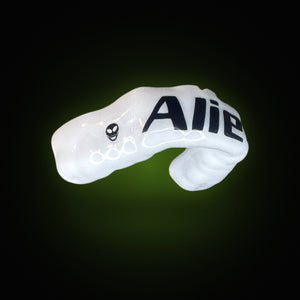
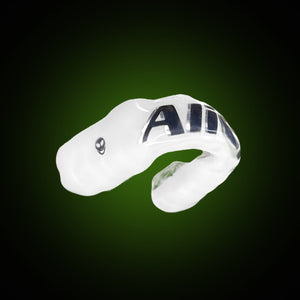
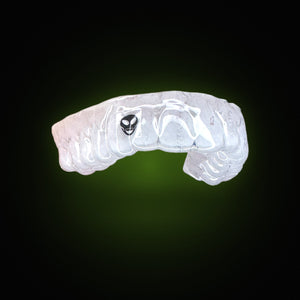
AlienGuards makes upper mouthguards. We don't sell a lower or double guard, so if your dentist says you need lower coverage, email support@alienguards.com before you order. For upper teeth with crowns, bridges, implants, veneers or a gap, pick the guard built for your sport:
- NanoBite (4 mm), our slimmest guard, for team and field sports such as football, hockey, field hockey, lacrosse, soccer, basketball and rugby, plus wrestling, BJJ and kids' sports.
- Origin and Origin Pro (5 mm) for combat sports only: boxing, MMA, Muay Thai, kickboxing, karate and taekwondo. Origin Pro also has an optional High Impact 6 mm upgrade.
- PowerBite for weightlifting and powerlifting.
Every guard is pressure-formed and finished by hand in our lab from your impression. Add Impression Storage when you build to keep your model on file, but remember that a stored model is only good until your teeth change. If a new guard doesn't fit properly, our refund and remake policy covers a free remake first. Not sure which model? Compare all models, or read how to choose the right mouthguard for your sport. Coaches ordering for a team can see team orders.
Mouthguards with dental work: FAQ
Can you wear a mouthguard with crowns?
Yes. A firmly cemented crown is part of the shape of your mouth, and a custom guard made from an impression fits around it like your natural teeth. If a crown is temporary or loose, see your dentist before taking an impression.
Can you wear a mouthguard with a dental bridge?
Yes. MouthHealthy says a properly fitted mouthguard may be especially important for people with fixed bridge work. A removable bridge is a removable appliance, so ask your dentist whether it should come out for sport.
Do I need a mouthguard if I have dental implants?
If you play a contact sport, yes. In one lab study, a mouthguard reduced strain on implant models and absorbed 40% to 46% of the impact energy. Ask your dentist when the implant is healed enough for contact sport and for an impression.
Can a mouthguard damage veneers?
A well-fitted guard covers veneers like the rest of the arch. In lab studies, a 4 mm guard reduced impact stress on veneered teeth, and no veneers cracked under a guard in one impact test. If your guard feels like it pulls on a veneer edge, have your dentist check the fit.
Can I wear a mouthguard with missing teeth?
Yes. The ADA says a guard should cover all remaining teeth on one arch, and a custom guard is formed on a model of your mouth, gap included. Check the fit each season and after any new dental work.
Should I wear my partial denture under my mouthguard?
Ask your dentist. MouthHealthy says not to wear removable appliances during contact sports, while the ACP says a guard can be made with the partial in place or, at the dentist's choice, without it. An at-home impression is taken with removable appliances out.
How long after dental work can I take a mouthguard impression?
Wait until the work has fully healed and your final crown, bridge or veneer is in, and follow your dentist's timing. Don't use an at-home kit over loose teeth, loose crowns or bridges, or dental work that hasn't healed.
Do I need a new mouthguard after getting a crown or veneer?
Usually, yes. Dental work can change the shape of your teeth, so a guard made before it may not fit afterward. Contact us before reordering from a stored model if you've had dental work since your last impression.
Sources: American Dental Association, Athletic mouth protectors (mouthguards); ADA MouthHealthy, Mouthguards, Crowns, Bridges, Implants and Veneers; American College of Prosthodontists, Mouthguard Use in Sports position statement (2015); American Academy of Pediatric Dentistry, Policy on prevention of sports-related orofacial injuries, Reference Manual of Pediatric Dentistry 2026; Carvalho et al., International Journal of Oral and Maxillofacial Implants 2018; Miyahara et al., Dental Traumatology 2013; Gonçalves et al., Computer Methods in Biomechanics and Biomedical Engineering 2026; Bragança et al., Dental Traumatology 2021; Dal Piva et al., Dental Traumatology 2023; de Bragança et al., Dental Traumatology 2023; Gialain et al., Dental Traumatology 2014; Abuhammoud et al., Journal of Prosthetic Dentistry 2026. Checked November 14, 2026.