

Do You Need a Bottom Mouthguard? Upper vs Lower Guards
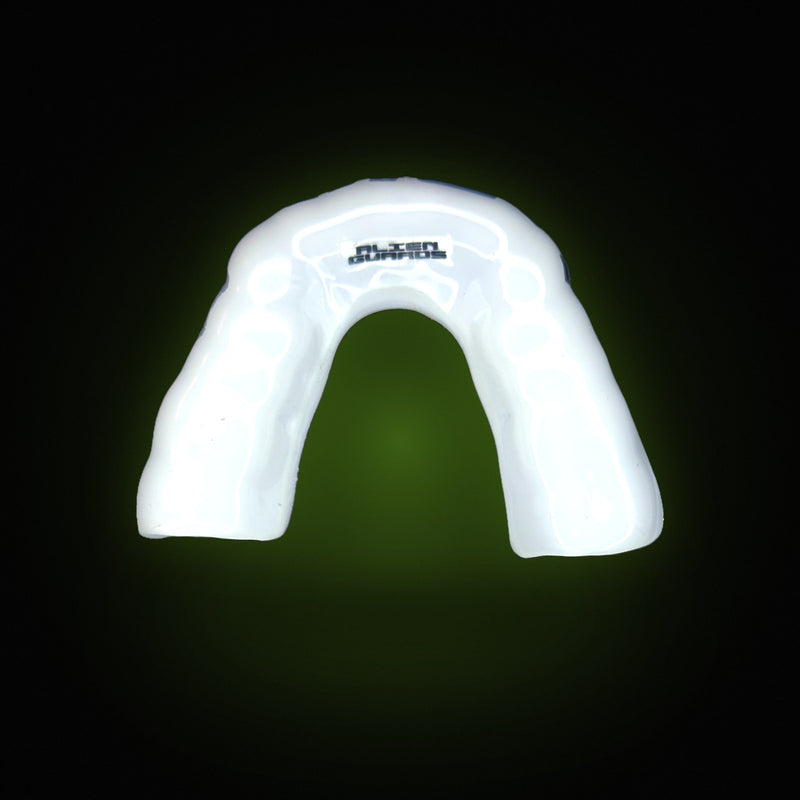
Nearly every mouthguard on a store shelf goes on the top teeth, so it's fair to wonder whether your bottom teeth are left unprotected, and whether you should be wearing a lower mouthguard or a double guard that covers both. For most athletes the answer is no: one well-fitted upper guard is the standard. But there are real exceptions, including an underbite, braces on the lower teeth and a handful of combat-sport rule books. This guide explains why guards go on top, how an upper guard still protects your lower teeth and jaw, and when a lower or dual-arch guard is the better choice.
It draws on the American Dental Association (ADA), its MouthHealthy site, the American Academy of Pediatric Dentistry (AAPD), the National Federation of State High School Associations (NFHS), published studies and current sport rule books. It's general information, not dental advice. If you have an underbite, braces, a retainer or recent dental work, talk to your dentist or orthodontist.
The short answer
- Most people need an upper guard only. The ADA says an ideal mouthguard covers all remaining teeth on one arch, customarily the upper (maxillary) arch.
- Your bottom teeth still benefit. When you bite down, a properly fitted upper guard sits between your top and bottom teeth, cushioning both and helping steady the lower jaw.
- Underbite? Think lower. The NFHS prefers a guard on the lower teeth if they stick out farther than the upper teeth, and the AAPD recommends a lower (mandibular) guard for a Class III bite.
- Braces on the bottom teeth? MouthHealthy says your dentist or orthodontist may suggest a guard on the lower teeth too.
- Some combat sports have their own rules. Kickboxing (WAKO), MMA (IMMAF) and taekwondo (World Taekwondo and USA Taekwondo) all say something about lower coverage when braces are involved.
Why mouthguards go on the upper teeth
It comes down to where injuries happen. The AAPD policy on sports-related orofacial injuries says most sport-related dental and facial injuries affect the upper lip, the upper jaw and the upper front teeth, with 50% to 90% of dental injuries involving the upper incisors. The ADA makes the same point in its guidance: a mouthguard should give a protective surface on the arch considered to be at highest risk of injury, which is typically the upper jaw.
The MouthHealthy mouthguard page puts it in plain terms. It says mouthguards typically cover the upper teeth and quotes Dr. Thomas Long, team dentist for the Carolina Hurricanes hockey team: "Your top teeth take the brunt of trauma because they stick out more." And: "Your bottom teeth are a little more protected because they are further back."
The standards agree. The AAPD policy notes that the ASTM, the standards body that classifies mouthguards, recommends that for maximum protection, cushioning and retention, a mouthguard should cover all teeth in at least one arch, customarily the upper, less the wisdom teeth. A 2017 review in the Primary Dental Journal (Green) describes the mouthguard as usually worn on the upper arch, working by separating the upper and lower teeth.
Your lower teeth still play a part: they bite into the upper guard, which is why fit matters so much. If your upper guard keeps slipping, that's a fit issue, not a sign you need a second guard. See how should a mouthguard fit? and why does my mouthguard fall out?
How an upper guard protects your lower teeth and jaw
An upper guard isn't only about the top teeth. When you close your mouth on it, the guard sits between both rows of teeth. The NFHS says a properly fitted mouthguard should separate the biting surfaces of the teeth and protect the lips, gums and teeth. The AAPD describes several ways a guard helps both arches:
- Cushioning between the jaws. By providing cushioning between the upper and lower jaw, the AAPD says mouthguards may reduce the incidence or severity of injuries where the jaw joint is forced out of position.
- Steadying the lower jaw. A guard redistributes shock during hard impacts and, per the AAPD, lowers the likelihood of jaw fracture partly by stabilizing the lower jaw.
- A buffer for soft tissue. The guard separates the teeth from the lips and cheeks, helping prevent cuts inside the mouth.
That protection depends on how your bottom teeth meet the guard. The ADA notes that one study recommended making custom guards with balanced occlusion and as many contacts as possible with the lower front teeth, to reduce the risk of the guard being knocked out of place. The AAPD adds that the Academy for Sports Dentistry recommends establishing proper front-tooth contact between the upper and lower arches when a guard is made, because it helps absorb and spread the force of impact.
Lab research points the same way. In a 2004 study on an artificial skull model (Takeda and colleagues), the lower jaw bent more as the area of bite support on the guard got smaller, and the authors concluded that a guard with insufficient occlusion could raise the risk of a lower-jaw fracture, so mouthguards should have proper occlusion. A 2009 study of custom guards (Geary and colleagues) found that flattening the biting surface increased contact with the opposing lower teeth and reduced how far the jaws were pushed apart in side-to-side movements, which the authors suggested may help comfort and protection. These are lab studies, not proof that a guard prevents jaw fractures on the field.
So your bottom teeth are protected through the guard on top, as long as they land on it evenly. For more, read mouthguards for preventing jaw injuries.
When a lower mouthguard makes sense
Your lower teeth stick out past your upper teeth
The NFHS position statement on mouthguards (2022) says mouthguards that cover the lower, rather than the upper, teeth are preferred if the lower row of teeth sticks out farther than the upper teeth, meaning the lower teeth are the leading edge. The AAPD says a lower guard is recommended for people with a Class III malocclusion, the dental name for an underbite. The World Taekwondo mouthguard rules build the same exception in: athletes without braces must wear at least a full upper guard, or a lower guard if they have a Class III bite.
If your bottom teeth are the ones out front, they're the ones that take the first hit. Only a dentist can tell you whether your bite counts as Class III.
You have braces on your lower teeth
MouthHealthy says a properly fitted guard may be especially important for people with braces, because a blow to the face can damage brackets, and a guard puts a barrier between the braces and your cheeks and lips. It adds that although some mouthguards only cover the upper teeth, your dentist or orthodontist may suggest a guard on the lower teeth if you have braces on them. Several combat-sport rule books also single out lower braces (see below).
Everything about guards and braces, including how impressions work when you have brackets, is in mouthguards for orthodontic patients.
What is a double (dual-arch) mouthguard?
A double mouthguard, also called a dual-arch or bimaxillary guard, covers both the upper and lower teeth. A 1997 paper in the Journal of Prosthodontics (Milward and Jagger) describes how to make one, connecting the upper and lower parts with an extra layer of material over the outside, and says this type provides enhanced protection in contact sports.
More coverage can come at a cost in comfort and breathing. World Taekwondo's braces rules reflect that trade-off: they call a double guard the best protection for athletes with braces, but allow a full upper guard plus a partial lower guard for athletes with severe breathing problems. If breathing is a concern for you, see can you breathe and talk with a mouthguard?
What sport rules say about lower and double guards
In the rule books we checked, lower coverage comes up mainly in combat sports, and mostly for athletes with braces. Here's what the current documents say. Rules change, so confirm with your league or event before you compete.
- High school sports (NFHS). The NFHS position statement defines a properly fitted guard as one that fully covers all of the upper teeth, with the lower guard preferred when the lower teeth stick out farther. See mouthguard rules by sport for which NFHS sports require a guard, and wrestling mouthguard rules for the high school braces rule.
- Roller derby (WFTDA). WFTDA's Guide for Equipment Check says a mouthguard should cover all teeth on the upper or lower jaw. More in roller derby mouthguard rules.
- Kickboxing (WAKO). The WAKO Equipment Book allows protection on only the upper teeth or on both upper and lower teeth. It also says a kickboxer with braces on the lower teeth, or on both, must wear a guard on both the upper and lower teeth, and that a guard over braces isn't allowed without a dentist's certificate. More in kickboxing mouthguard rules.
- Amateur MMA (IMMAF). The IMMAF 2026 adult MMA rules summary says braces require the protective mouthguard, and a double mouthguard is mandatory when braces are fitted to both upper and lower teeth. See MMA mouthguard rules.
- Taekwondo (World Taekwondo). Without braces: at least a full upper guard covering all the upper teeth back to at least the first molar, or a lower guard for a Class III bite. With braces, three options in order of preference: a double guard covering both arches and braces (strongly recommended), a full upper guard plus a partial lower guard (allowed for severe breathing problems), or a full upper guard plus a brace shield for the lower braces (the least favorable option).
- Taekwondo (USA Taekwondo). The USA Taekwondo Equipment and Hygiene Standards say athletes without braces must wear a full upper guard covering the upper teeth at least to the first molar. Athletes with braces get the same three options, with the partial lower guard required to cover at least 6 lower teeth. See karate and taekwondo mouthguard rules.
For a sport-by-sport table of braces rules, see the braces rules by sport section of our orthodontic guide. Comparing striking sports? Our boxing vs MMA mouthguard guide covers the differences.
Kids, growing teeth and lower guards
Most kids and teens wear an upper guard, just like adults. Two things are different: many are in braces, and their mouths keep changing. The AAPD notes that with teeth shifting during orthodontic treatment, baby teeth falling out and adult teeth coming in, a custom guard may not fit a young athlete for long after the impression is taken. MouthHealthy says children and teens may need new mouthguards more often for the same reason.
Whatever type your child wears, check the fit every season. Our kids and youth mouthguards guide covers sizing, rules and how to tell when a guard no longer fits.
A bottom night guard is not a sports guard
Some people already wear a guard on their lower teeth at night for grinding or clenching, and wonder whether it can double as a sports guard. It can't. The World Taekwondo rules say athletes must not use guards designed for anti-grinding, commonly called night guards or orthodontic splints, because they aren't designed to protect an athlete from a sports injury. A retainer isn't a sports guard either; MouthHealthy says not to wear a retainer or other removable appliance during contact sports. See can you wear a mouthguard with a retainer? If you grind your teeth, see night guard vs sports guard and ask your dentist about a separate night guard.
How to decide what you need
- Check your bite. When you close your mouth normally, do your top front teeth sit in front of your bottom ones? If yes, an upper guard is the standard. If your bottom teeth sit in front, ask your dentist about a lower guard.
- Check for braces. Braces on the bottom teeth? Talk to your orthodontist about lower coverage before your season starts.
- Read your rule book. Kickboxing, amateur MMA and taekwondo have specific rules for braces and lower coverage.
- Get the upper fit right. Your bottom teeth should meet it evenly on both sides when you bite. Thickness matters too; see how thick should a mouthguard be?
What AlienGuards makes
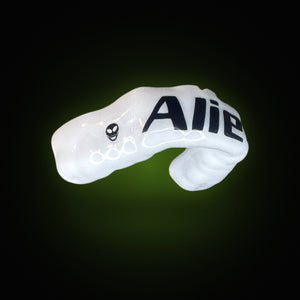
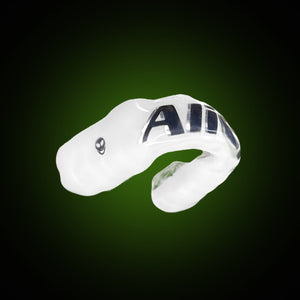
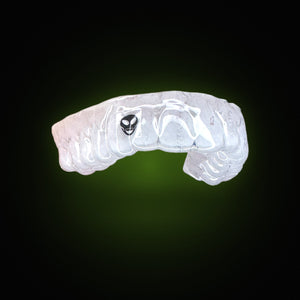
AlienGuards makes upper mouthguards. We don't sell a lower or double (dual-arch) guard. Every AlienGuard is made from an impression of your own teeth, taken at home with our kit by following the impression guide, and pressure-formed and hand-finished on a model of your teeth in our lab. The sizing and fit guide explains how kit sizing and thickness work. If you choose Impression Storage when you build, we keep your model on file for future reorders, as long as your teeth haven't changed.
If you have an underbite, braces on your lower teeth, or compete under rules that require lower or double coverage, talk to your dentist or orthodontist first, and email support@alienguards.com before you order so we can help you work out whether an AlienGuard fits your situation. If you wear braces at all, don't use the at-home kit; your dentist or orthodontist takes the impression or a 3D scan instead.
For a normal bite, pick the upper guard built for your sport:
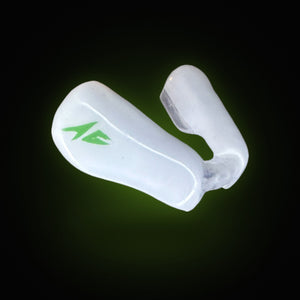
- NanoBite (4 mm), our slimmest guard, for team and field sports such as football, hockey, field hockey, lacrosse, soccer, basketball and rugby, plus wrestling, BJJ and kids' sports.
- Origin and Origin Pro (5 mm) for combat sports only: boxing, MMA, Muay Thai, kickboxing, karate and taekwondo.
- PowerBite for weightlifting and powerlifting.
Not sure which? Compare all models, or read how to choose the right mouthguard for your sport.
Upper vs lower mouthguards: FAQ
Do you need a bottom mouthguard?
Usually not. The ADA says an ideal mouthguard covers all the teeth on one arch, customarily the upper. A lower guard is mainly for people whose lower teeth stick out past the upper teeth, people with braces on the bottom teeth, or athletes whose rule book requires it.
Does an upper mouthguard protect your bottom teeth?
Yes, to a degree. When you bite down, the guard sits between your top and bottom teeth. The NFHS says a properly fitted guard should separate the biting surfaces of the teeth, and the AAPD says guards cushion between the jaws and help stabilize the lower jaw.
Which teeth should a mouthguard go on?
The upper teeth for most people. The NFHS says a properly fitted guard should fully cover all of the upper teeth. If your lower teeth are the leading edge, as with an underbite, the NFHS prefers a guard on the lower teeth instead.
Should I wear a mouthguard on my bottom teeth if I have an underbite?
Ask your dentist. The AAPD recommends a lower (mandibular) guard for a Class III bite, the dental term for an underbite, and World Taekwondo allows a lower guard instead of an upper one for athletes with a Class III bite.
Do I need a top and bottom mouthguard with braces?
Only in some cases. MouthHealthy says your dentist or orthodontist may suggest a lower guard if you have braces on the bottom teeth. WAKO kickboxing requires guards on both arches with lower braces, IMMAF MMA requires a double guard with braces on both arches, and taekwondo strongly recommends one.
Are double mouthguards better?
They cover more teeth, and World Taekwondo calls a double guard the best protection for athletes with braces. But World Taekwondo also allows a full upper guard plus a partial lower guard for athletes with severe breathing problems. For most athletes with a normal bite, a well-fitted upper guard is the standard.
Can I use my night guard as a sports mouthguard?
No. A night guard for grinding isn't designed to protect against sports injuries, and World Taekwondo rules ban anti-grinding guards in competition. Wear a sports mouthguard for training and games.
Does AlienGuards make lower or double mouthguards?
No. AlienGuards makes upper mouthguards from an impression of your teeth. If you need lower or double coverage, talk to your dentist or orthodontist and email support@alienguards.com before you order.
Sources: American Dental Association, Athletic mouth protectors (mouthguards); ADA MouthHealthy, Mouthguards; American Academy of Pediatric Dentistry, Policy on prevention of sports-related orofacial injuries, Reference Manual of Pediatric Dentistry 2026; NFHS Sports Medicine Advisory Committee, Position statement and recommendations for mouthguard use in sports (2022); Green, Primary Dental Journal 2017; Takeda et al., Dental Traumatology 2004; Geary et al., Oral Health and Preventive Dentistry 2009; Milward and Jagger, Journal of Prosthodontics 1997; World Taekwondo, Mouthguard, taping, bracing and piercing rules (reviewed by FDI sports dentistry experts, February 10, 2020); USA Taekwondo, Equipment and Hygiene Standards; WAKO Equipment Book (Rev. 7, 2026); IMMAF 2026 Adult MMA Rules Summary. Checked November 14, 2026.