

The Perfect Fit: How a Custom Mouthguard Helps You Play
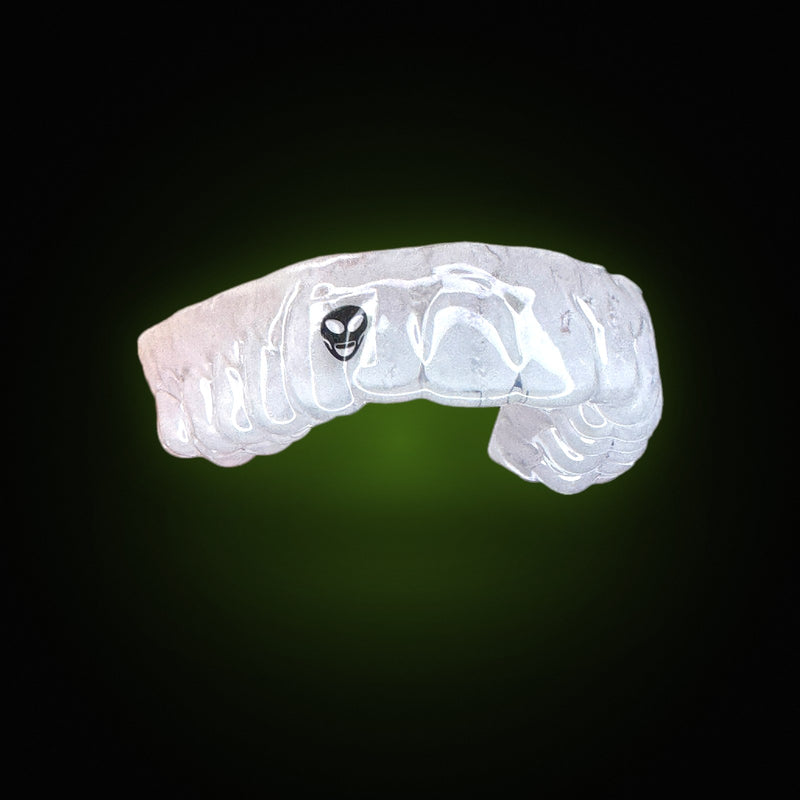
A mouthguard can only protect you if it stays in your mouth and you're willing to wear it every session. That's why fit matters more than any other feature. A guard that rocks, slips or makes you gag ends up in your hand, your sock or the bottom of your bag, and then it protects nothing. That holds on the mats too, where a mouthguard is optional at most jiu-jitsu events; see BJJ mouthguard rules.
This guide covers what a good fit actually means, what the research says about fit, breathing, talking and performance, the signs your guard doesn't fit, and how we make sure yours does. We'll also be straight about what a mouthguard won't do for your game.
The short answer
- A good fit keeps the guard in place on its own, so you don't have to clench to hold it and it's where it should be when a hit lands.
- Fit drives whether athletes wear a guard at all. Not being able to breathe or talk, and discomfort, are among the most common reasons athletes give for skipping one. More in mouthguard myths debunked.
- Well-fitted custom guards don't hurt performance in studies. They don't boost it either. Their job is protection.
- Most people adjust within weeks. Speech and comfort improve with regular wear.
What "a good fit" means
According to the American Dental Association (ADA), an ideal mouthguard should be properly fitted and accurately adapted to your mouth, cover all your remaining teeth on one arch (usually the upper), stay in place comfortably and securely, be easy to clean, and absorb impact energy to limit the force that reaches your teeth.
The ADA describes three types:
- Stock guards come pre-formed in a few sizes. The ADA calls them the least effective type, because they aren't adapted to your mouth, need your mouth shut to stay in, and need frequent repositioning.
- Boil-and-bite guards are softened in hot water and shaped by biting into them. The fit depends on how well that goes at home.
- Custom guards are made on a model of your teeth. Many consider them the most protective, though the ADA notes other types can also be effective if they're properly made and worn.
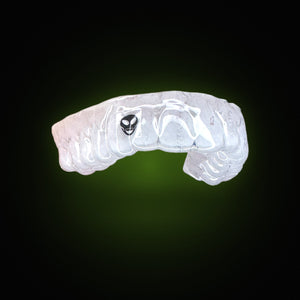
In practice, a good fit means the guard snaps onto your upper teeth, covers them fully, stays there when you open your mouth, and doesn't press into your gums, cheeks or the back of your mouth. More in custom vs. boil-and-bite.
Why fit decides whether you wear it
The best guard is the one that's in your mouth when the hit comes. Several studies show how often comfort and fit are what get in the way:
- In a 2015 survey of 1,636 high school basketball and baseball/softball players, only 12.3% said they wore a mouthguard every time or sometimes. The top reasons for not wearing one were that it wasn't required (65.3%) and that they couldn't breathe or talk with one in (61.5%).
- In a 2016 survey of 494 junior rugby league players and coaches in Australia, about two-thirds of players wore a guard, most often a boil-and-bite. The authors concluded that players' compliance is largely influenced by whether they think guards work and how comfortable they are.
- In a 2008 study of children given free mouthguards, only 23.2% wore theirs whenever needed a year later. 44.9% of the children said they didn't wear it because they forgot, and 42% because it wasn't comfortable.
- In a 1994 JADA study of high school athletes, both custom and self-adapted guards offered adequate protection, but the athletes preferred the custom guard for comfort and wearability.
The takeaway: a guard you like wearing protects you far more than a guard that lives in your bag.
What lab studies say about fit and retention
Two lab studies looked at what controls retention, a guard's ability to stay on your teeth without help.
- Accuracy matters more than outline. In a 2009 study in Quintessence International (Maeda and colleagues), researchers made 4 mm guards on the same model of upper teeth using different methods, then measured the force needed to pull each one off. Guards formed on a well-dried model, or with a pressure-forming machine, held on with about twice the force of guards formed on a wet model. The authors concluded that retention depends mainly on how accurately the guard fits where the teeth narrow toward the gumline, not on where its edges end.
- Trimming helps comfort without loosening the guard. In a 2006 study in the British Journal of Sports Medicine (Maeda and colleagues), 17 volunteers wore a custom guard that was trimmed and finished in five steps. Trimming the palate side back toward the gumline, smoothing the edges and adjusting the bite significantly improved comfort, breathing, speaking and swallowing. Retention didn't change at any step.
Put together: a guard formed accurately on a model of your teeth holds itself in place, and careful finishing on the palate side makes it easier to wear without costing it grip. These were small lab studies, not injury trials, but they explain why the making process matters as much as the material.
Fit and breathing
"I can't breathe with it in" is one of the most common complaints. With a guard that fits closely, the research is reassuring:
- A 2011 study of 27 field hockey and water polo players found no significant difference in ventilation or oxygen uptake with two types of custom mouthguards compared with none, up to maximal effort.
- A 2020 study of 24 college lacrosse players tested boil-and-bite and custom guards. The differences in breathing and heart rate were negligible and of little practical significance.
A guard that sits flat against your teeth leaves more room for air than a bulky guard you have to bite down on. If breathing is your top priority, a slimmer model helps. More in can you breathe, talk and drink with a mouthguard?
Fit and talking
Expect your speech to sound a little different at first. In a 2024 study of 30 national rugby players who got custom-fitted mouthguards, speaking difficulty and lisping dropped significantly over time, the bulky feeling faded, and players' comfort and support for wearing guards grew. A 2016 study comparing 168 custom and boil-and-bite guards found that most of them didn't cause problems with speech, breathing, gagging or other mouth functions for the majority of users; one standard boil-and-bite model caused the most problems.
The fastest way to adjust is to wear your guard at every practice, not just on game day, and to practice calling plays or counting out loud with it in.
Fit and focus
- No clenching to hold it in. A guard made from your impression stays put on its own, so your jaw can relax between efforts.
- No fiddling. No pushing a loose mouthguard back into place, no pulling it out between plays.
- Less gagging. A guard that's trimmed to your mouth and doesn't shift is less likely to touch the back of your palate. More in mouthguards and gag reflex.
What a good fit won't do
You'll see claims that a mouthguard boosts strength, power or endurance. We don't make those claims. A 2019 systematic review of 15 trials found custom-made mouthguards neither impaired nor improved athletic performance compared with no guard, and that custom guards showed the smallest range of changes of any type. The authors cautioned that study methods varied a lot. A sports guard isn't a night guard either; see teeth grinding and bruxism.
A mouthguard also isn't concussion protection. The ADA describes that evidence as mixed (see do mouthguards prevent concussions?). What a well-fitted guard does is protect your teeth, lips, cheeks and jaw, without getting in your way. The research behind that is in the science behind mouthguard protection.
Signs your mouthguard doesn't fit
- It falls out or drops when you open your mouth.
- You have to bite down to keep it in place.
- It rocks or shifts when you push on it with your tongue.
- It makes you gag or presses on the back of your palate.
- The edges dig into your gums or cheeks, or leave sore spots.
- It doesn't cover all your upper teeth, including the back ones.
- It fit once but doesn't now, after heat exposure, new dental work or (for kids) growth.
A guard that used to fit and now doesn't may have warped or worn out; see how long custom mouthguards last.
Keeping the fit all season
A good fit doesn't last forever. In a 2007 study in the Journal of Athletic Training (Del Rossi and colleagues), researchers measured custom-made guards worn by 15 high school varsity football players across a season. After six weeks, the guards were about 16% thinner at the front teeth and 23% thinner at the molars, and their shape had changed too. Four of the 15 players lost their guards before the season ended. The authors advised checking guards often to make sure fit and protection haven't slipped.
A fit check takes under a minute. Do it at the start of each season, every few weeks during it, and after any dental work:
- Put the guard on your upper teeth and open wide. It should stay up without you biting or sucking on it.
- Push on it with your tongue. It shouldn't rock or lift away from your teeth.
- Look at the biting surfaces, especially over your back teeth. Bite-through spots, thin patches or chewed edges mean the material that absorbs a hit is wearing away.
- Talk and take a few deep breaths with it in. If that's harder than it used to be, the guard may have shifted or warped.
Fit for growing athletes
Kids and teens are a special case. Their mouths keep growing and their teeth keep changing, so a guard that fit perfectly last season can feel tight or loose this one. The ADA's MouthHealthy site notes that children and teens may need to replace their guards more often. Check the fit at the start of every season and after any dental work. With Impression Storage, reorders are 20% off and you can reorder without a new impression as long as the teeth haven't changed; for a growing athlete, a fresh impression is often the better choice. More for parents in custom mouthguards for kids.
How we get your fit right
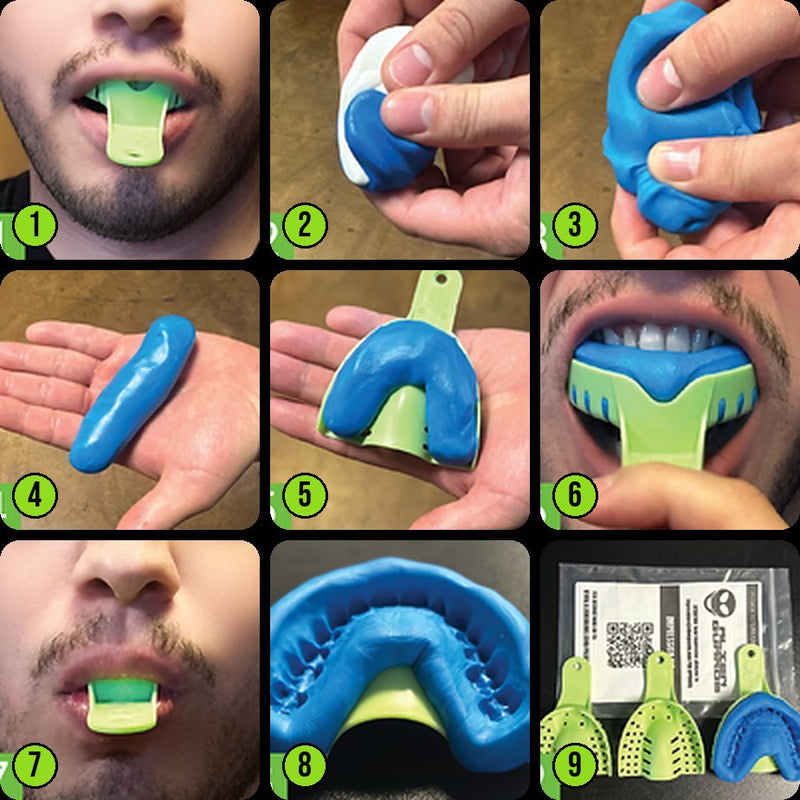
- Build your guard online and we ship an at-home impression kit with trays, putty, instructions and a return label.
- Take your impression (bite and hold for 2 minutes 30 seconds), following our impression guide.
- Email us a photo of your impression. We confirm it's good before you mail it back.
- We pour a model of your teeth, pressure-form your guard on it and finish it by hand. It's crafted within 10–14 business days after we receive a good impression. See how it's made.
If your guard doesn't fit properly, our refund and remake policy starts with a free remake. Email support@alienguards.com with your order number and a short description (a photo of the guard on your teeth helps). If the remake still isn't right, you get your money back for the mouthguard.
Athletes with braces can get AlienGuards, but their dentist needs to take the impression instead of using our at-home kit, so the braces don't get damaged. The dentist can take an impression or 3D scan, then ship it to us or email it to impressions@alienguards.com. More in mouthguards with braces.
Which AlienGuard fits your sport
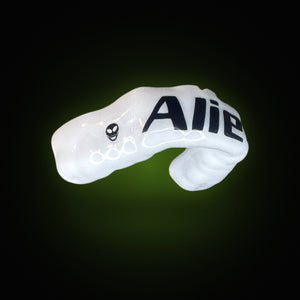
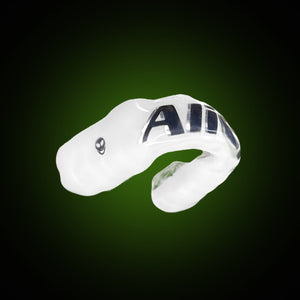
- Breathing and talking first: NanoBite is our thinnest guard at 4 mm, for team sports including football, basketball, soccer, lacrosse, hockey, field hockey and rugby, and for wrestling and BJJ. Basketball players: see basketball and dental health.
- Boxing, MMA, Muay Thai, kickboxing, karate and taekwondo: Origin (5 mm, reinforced impact zones) or Origin Pro (5 mm, more breathable, optional High Impact 6mm upgrade). Compare the two biggest fight sports in boxing vs. MMA mouthguards. Boxers can check boxing mouthguard rules.
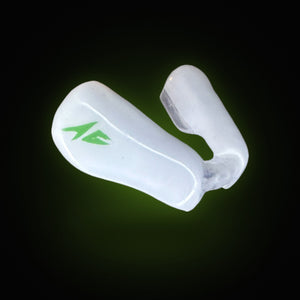
- Lifting: PowerBite gives you a stable platform to clench on under load.
Metallic, satin and holographic text colors are free on every model. Ordering for a team or gym? You get 20% off every model, including NanoBite and PowerBite, with a minimum of 5; see team orders.
Keep reading: custom mouthguards for soccer players, compare all four models and how thick should a mouthguard be? To see which sports require a guard, read mouthguard rules by sport. Need it by a certain date? See how long a custom mouthguard takes.
Mouthguard fit FAQ
How should a mouthguard fit?
It should cover all your upper teeth, stay in place when you open your mouth without you biting down, and not press into your gums, cheeks or the back of your palate. The ADA says an ideal guard is accurately fitted and stays in place comfortably and securely. For a step-by-step fit check, see how should a mouthguard fit?
Does a custom mouthguard improve performance?
No study has shown that. A 2019 systematic review found custom-made guards neither impaired nor improved performance. What a good fit gives you is protection that doesn't get in your way. Lifters can see the studies on clenching and strength in do mouthguards help lifting?
Can I breathe normally with a custom mouthguard?
In studies of field hockey, water polo and lacrosse players, well-fitted guards made little or no practical difference to breathing during exercise. A slim, close-fitting guard leaves the most room for air.
How long does it take to get used to a new mouthguard?
Most athletes adjust within a few weeks. In a 2024 study of rugby players, speech problems, the bulky feeling and nausea all improved with regular wear. Wear it at every practice to adjust faster.
What if my AlienGuard doesn't fit?
Email support@alienguards.com with your order number and a short description. Under our refund and remake policy, we start with a free remake, and if the remake still isn't right, you get your money back for the mouthguard.