

Rugby Players: Shield Your Smile with a Custom Mouthguard
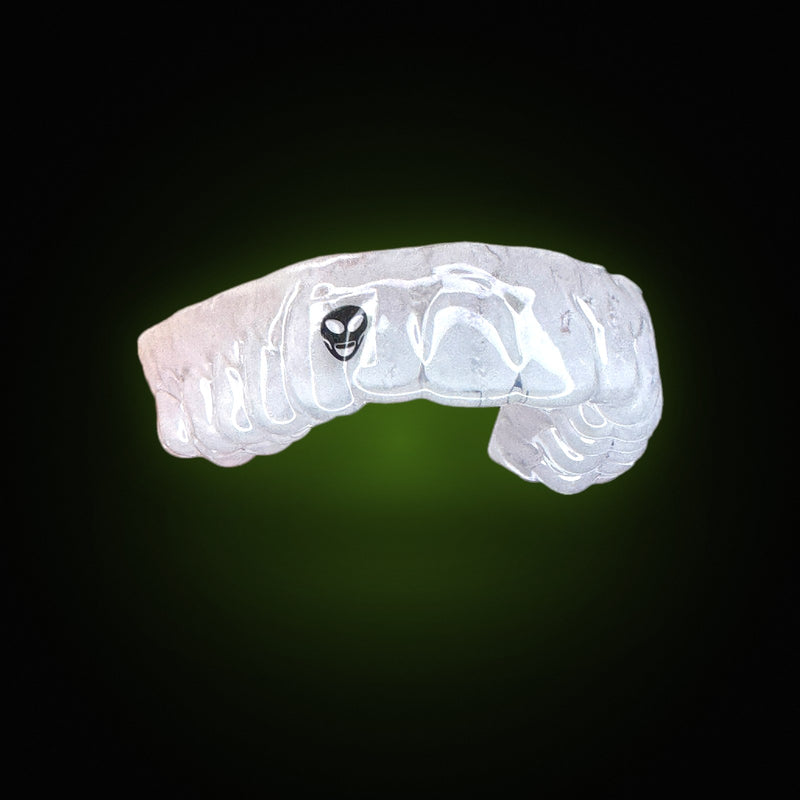
Rugby is a collision sport. Tackles, rucks, mauls and scrums bring heads, shoulders and knees close to your face all match, with no helmet or face guard. This guide covers what rugby does to your mouth, what World Rugby and dental groups say about mouthguards, what to look for in a rugby guard, and how to get one that stays in from the first scrum to the final whistle. For what a good fit means, see how a custom fit helps you play.
Why rugby players need a mouthguard
The American Dental Association (ADA) lists rugby among the contact and collision sports where it recommends a properly fitted mouthguard. It notes that the American Academy of Pediatric Dentistry (AAPD) also recommends mouthguards for contact and collision sports. Compare sports in mouthguards for contact sports.
The ADA summarizes a 2019 systematic review and meta-analysis that found mouthguard users were 82% to 93% less likely to suffer dentofacial injuries than non-users. Broken tooth crowns and knocked-out teeth were the most common injuries. That review compared athletes who wore a mouthguard with athletes who didn't, across sports. It doesn't show that one brand or type beats another, and no mouthguard prevents every injury.
World Rugby's own player welfare guidance is even more direct. Its Rugby Ready equipment page strongly recommends that all players wear a custom-made mouth guard in practice and matches. It says a good mouth guard protects the teeth and surrounding soft tissue and can prevent a broken jaw. It also points to New Zealand, where mouth guards became compulsory in 1997. The peer-reviewed evaluation of that rule (a 2005 evaluation in the British Journal of Sports Medicine, Quarrie and colleagues) found that rugby-related dental injury claims fell by 43% from 1995 to 2003.
What rugby does to your mouth
- Chipped, cracked and broken teeth: a shoulder, head or knee in a tackle lands a lot of force on a small area, and the upper front teeth take most of it. More in how mouthguards protect teeth from chips and cracks.
- Knocked-out teeth: a tooth knocked out of its socket is a dental emergency, and the first few minutes decide whether it can be saved. Every coach and team manager should know what to do if a tooth is knocked out.
- Cuts to the lips, cheeks and tongue: without a guard, your own teeth cut the inside of your mouth on contact. A guard puts a smooth, cushioned layer in between.
- Jaw impacts: a guard that fits well helps spread the force of a blow and stops your teeth slamming together. See mouthguards and jaw injuries.
Most contact happens in training, not just on match day, so wear your guard every time there's contact.
Do you have to wear a mouthguard in rugby?
Under the World Rugby Laws of the Game, a mouthguard is recommended rather than mandatory for every match. Law 4 (Permitted clothing) says World Rugby recommends all players wear a mouthguard or dental protector (Law 4.2), and lists a mouth guard or dental protector as a permitted additional item (Law 4.3.f). The referee can still order a player to remove any item judged dangerous (Law 4.5).
In practice, many unions, clubs and schools go further and make a mouthguard compulsory. USA Rugby's Protective Equipment and Clothing Guidelines say mouth guards should be worn by every player, every time they play contact rugby, and that guards should not have pieces extending outside the mouth, such as a football helmet strap. Check your union, league or school handbook before the season starts. More in why every athlete needs a custom mouthguard.
For the full breakdown of Law 4, USA Rugby's gear sheet and club "no mouthguard, no play" policies, read our rugby mouthguard rules. For every sport in one place, see mouthguard rules by sport.
Did New Zealand's mouthguard rule work?
New Zealand is the best-studied example. In their 2005 evaluation, Quarrie and colleagues tracked rugby-related dental injury claims made to ACC, the country's accident compensation scheme. Mouthguards became compulsory in match play for under-19 grades at the start of the 1997 season and for all domestic grades in 1998, and referees got more enforcement powers in 2003.
- Self-reported mouthguard use rose from 67% of player-weeks in 1993 to 93% in 2003.
- Dental claims fell by 43% (90% confidence interval 39% to 46%) from 1995 to 2003.
- Assuming player numbers stayed about the same, the authors estimated that non-wearers had about 4.6 times the claim rate of wearers. A 2006 correction fixed the wording of that comparison, not the 43% figure.
It's an ecological study, and the authors say so: it tracks claims across the whole country rather than following individual players, so other changes over those years could play a part. Their conclusion was still that mouthguards are a simple and effective way to prevent injury, and they strongly recommended them for all players in matches and in contact training, even though the rule only covered matches.
Smart mouthguards and concussion
In October 2023, World Rugby announced that elite players would need to wear "smart" mouthguards, in training and matches, to use the in-game Head Injury Assessment. The sensors alert the independent matchday doctor to a high-acceleration event so the player can be assessed. The same announcement recommended mouthguards for players at all levels of the game.
A smart mouthguard measures head movement. It doesn't diagnose a concussion, and no mouthguard prevents one. The ADA says the evidence on mouthguards and concussion is mixed and less consistent than the evidence for dental injuries. Choose a mouthguard to protect your teeth, lips and jaw. Read do mouthguards prevent concussions? for more.
What to look for in a rugby mouthguard
The ADA says an ideal mouthguard is properly fitted, covers the teeth on one arch (usually the upper), stays in place comfortably and securely, and absorbs impact energy. World Rugby's Rugby Ready guidance stresses the same two things: fit, so the guard stays in and spreads forces, and the material and thickness that absorb energy. For rugby, that means:
- It stays in without clenching. A guard you have to bite down on to keep in place ends up in your hand or on the pitch after the first big hit. If yours already slips, read why does my mouthguard fall out?
- You can breathe and talk. Forwards call lineouts and everyone needs air after a long phase. A slim guard that fits closely leaves more room to breathe. See can you breathe and talk with a mouthguard?
- The right thickness. Read how thick should a mouthguard be? for how 4, 5 and 6 mm guards compare and which sports each suits.
Will a mouthguard affect your calls?
Most players adjust quickly. In a 2024 study of 30 national rugby players who got custom-fitted mouthguards, speaking difficulty and lisping dropped significantly over time. Their sense of nausea improved and leveled off after about a month, the bulky feeling faded, and mouth dryness steadily went away. If you gag easily, see mouthguards and gag reflex.
What studies of rugby players show
- New Zealand club players: in a 2005 cohort study that followed 304 Dunedin players weekly through the 1993 season, mouthguard users had a lower rate of orofacial injury (rate ratio 0.56), though the confidence interval was wide. Mouthguards did not lower concussion risk.
- Switzerland: a 2012 survey of 517 players from 19 clubs found 88.2% wore a mouthguard, about three-quarters of them tailor-made. Dental injuries were more common among forwards than backs, and juniors wore guards least.
- Australia: in a 2014 survey of adult amateur players in New South Wales, 64.9% had had an orofacial injury, and 41.9% of those injuries were to the teeth. Wearing a mouthguard was linked to fewer ongoing complications after a dental injury.
- Malaysia: a 2014 survey of 456 tournament players found only 31.1% used a mouthguard. Breathing problems and general discomfort were the main reasons players stopped.
The pattern is consistent: a guard only protects you if it's comfortable enough to keep in every session, which is why fit, breathing and speech matter so much in rugby.
Custom vs. boil-and-bite for rugby
The ADA describes three types of mouthguards. Stock guards come ready to wear and have to be held in by closing your mouth, so the ADA calls them the least effective type. Boil-and-bite guards are softened in hot water and shaped by biting, and the ADA warns that imprecise shaping can leave a poorly fitted guard. Custom guards are made from an impression of your own teeth, which the ADA says gives an optimal fit. One study it cites found custom guards were more comfortable and easier to wear.
World Rugby's Rugby Ready page says mouth guards made from a dental mold generally provide the best protection. The ADA adds that the best mouthguard is the one you actually wear. For the full comparison, read why custom mouthguards outperform boil-and-bite.
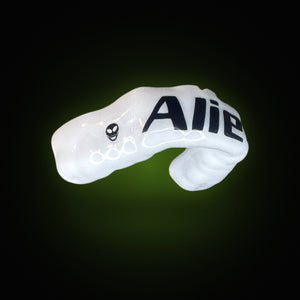
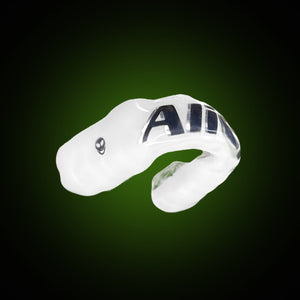
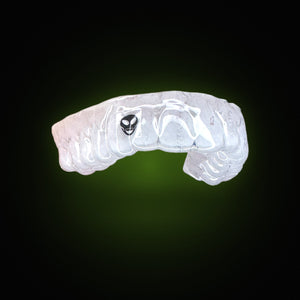
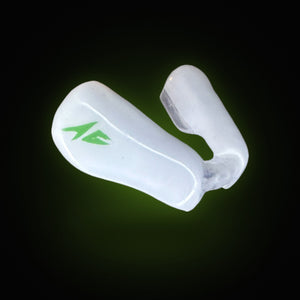
Which AlienGuard for rugby: NanoBite
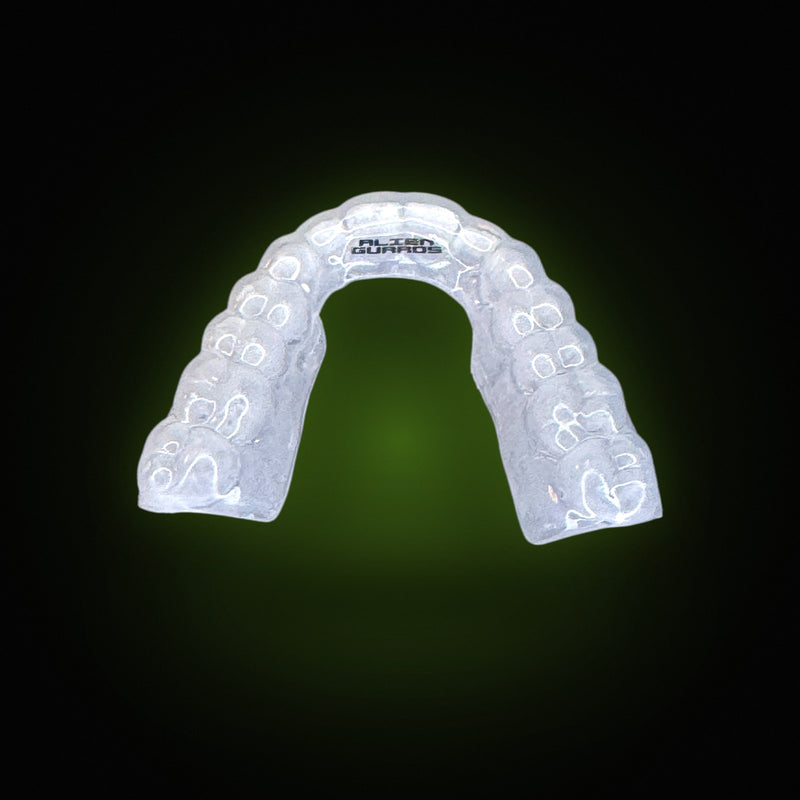
Our pick for rugby is NanoBite, our thinnest guard at 4 mm. It's our lowest-profile model and the best of our guards for breathing and talking, so you can keep working through phases and still call lineouts and moves. Play field hockey in the off-season? See field hockey mouthguard rules.
- Base colors: Clear, White or Black.
- Custom text: up to 3 characters, such as your squad number or initials, in your club color. Metallic, satin and holographic text colors are free. For design ideas, see choosing the right color and design for your mouthguard.
Origin and Origin Pro are our combat guards, made only for boxing, MMA, Muay Thai, kickboxing, karate and taekwondo. They are not our recommendation for rugby. PowerBite is for powerlifting and weightlifting only. To see all four side by side, compare models, or shop the rugby collection. For more on choosing, see our rugby mouthguard guide.
How to order a custom rugby mouthguard
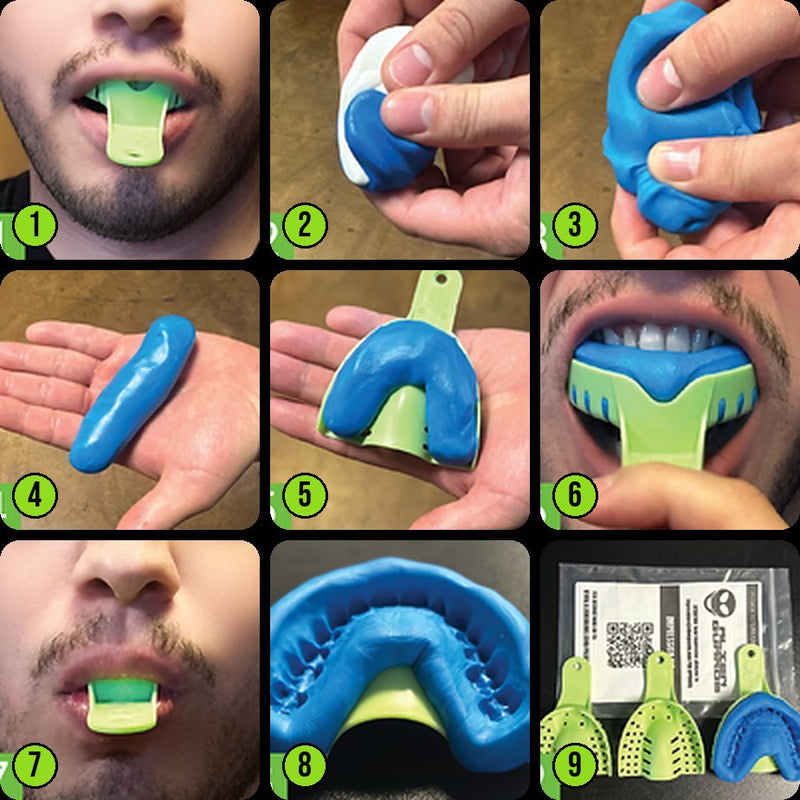
- Build your NanoBite. Pick your base color and custom text, and take a quick smile photo so we can pick your tray size. See sizing and fit.
- Take your impression at home. We ship you an impression kit. Taking the impression takes about 10 minutes. Follow the impression instructions, then mail it back. Here's how a custom mouthguard is made without a dentist visit.
- We make it. Your guard is crafted within 10–14 business days after we receive a good impression, then shipped with tracking. More in how long a custom mouthguard takes.
Plan around preseason. Order early enough to wear the guard in a few weeks of training before your first match.
Players with braces
Athletes with braces can get AlienGuards. Your dentist takes the impression or a 3D scan instead of using our at-home kit, so your braces don't get damaged. The dentist can ship it to us or email it to impressions@alienguards.com. More in can you wear a mouthguard with braces?
Junior and youth rugby
There's no age limit, so junior players can order too. Younger players' teeth and jaws are still changing, so their guards need checking and replacing more often as they grow. Parents can read our guide to custom mouthguards for kids and youth athletes.
Club rules for juniors vary a lot. A 2015 survey of Scottish Rugby Union clubs with junior teams found that only 17% (20 of 151) kept a junior out of a match for not wearing a mouth protector, and 11% kept them out of training. Fewer than 2% had a dentist on hand on match days, so it pays for parents and coaches to know what to do if a tooth is knocked out.
Care and replacement
Rinse your guard in cool water before and after every session, brush it gently with a soft toothbrush and mild soap, and let it air-dry in a vented case. Keep it away from hot water, dishwashers and hot cars so it keeps its shape. See how to clean and care for your custom mouthguard. Replace it every year, or sooner if it's torn, thinned out or loose. More in how often to replace your mouthguard. What wears a guard out: how long custom mouthguards last.
Ordering for a whole club
Clubs, schools and teams that order 5 or more mouthguards get 20% off through team orders, including NanoBite, with your club logo plus each player's name or number on every guard. We can also help with on-site fitting so every player takes a good impression (minimum order and location apply), and keep models on file for quick replacements (minimum order; athletes 14+ without braces). See custom mouthguards for gyms and teams. To match your club colors, see custom mouthguard designs.
Rugby mouthguard FAQ
Is a mouthguard required in rugby?
World Rugby Law 4 recommends a mouthguard or dental protector and lists it as permitted kit, but doesn't make it mandatory for every match. Many unions, clubs and schools require one anyway, and USA Rugby's gear guidelines say every player should wear one every time they play contact rugby.
What kind of mouthguard does World Rugby recommend?
World Rugby's Rugby Ready guidance strongly recommends a custom-made mouth guard for practice and matches, and says guards made from a dental mold generally provide the best protection.
Does a rugby mouthguard prevent concussions?
No. The ADA says the evidence on mouthguards and concussion is mixed. Smart mouthguards used in elite rugby measure head movement to help doctors decide who to assess, but they don't prevent or diagnose concussions. Choose a mouthguard to protect your teeth, lips and jaw.
Which AlienGuard is best for rugby?
NanoBite, our thinnest guard at 4 mm and the best of our models for breathing and talking. Origin and Origin Pro are for combat sports only, and PowerBite is for lifting.
Can rugby players with braces get a custom mouthguard?
Yes. Your dentist takes the impression or a 3D scan instead of using our at-home kit, then ships it to us or emails it to impressions@alienguards.com.